Why Penang Property Rental Yield is Structurally Different And Still a Win?
Hajar Abdullah
April 23rd, 2026
The Malaysian property market is often painted with a broad brush, but as any seasoned investor at FAR Capital will tell you: Penang is not KL.
If you are looking for a property in George Town or Tanjung Tokong expecting the same 6% rental yield you find in a mature Cheras high-rise, you are going to be disappointed.
But here is the secret, lower rental yield in Penang isn’t a sign of a weak market. It is a sign of a defensive, premium, and land-scarce asset class. While other markets are employment-driven, Penang is lifestyle-backed.
In this 2026 guide, we break down why the rental yield in the Pearl of the Orient operates under its own set of rules and why capital growth is the real “alpha” here.
Why Penang Is Structurally Different?
Unlike Kuala Lumpur, Selangor, or Johor Bahru, Penang’s property market works under a unique structure that shapes both prices and investor behavior.
While KL and Johor Bahru are largely:
Employment-driven – rental demand is closely tied to nearby jobs, offices, and corporate hubs.
Yield-sensitive – investors often focus on monthly cash flow.
High-rise heavy – the market is flooded with apartments and condos to absorb the workforce.
Penang Island, particularly the Timur Laut district, operates differently:
Land-scarce – geographic and zoning constraints limit supply.
Lifestyle-driven – buyers prioritize environment, coastal access, and heritage.
Seafront-constrained – beachfront plots are rare, creating a premium.
Capital-growth oriented – the focus is long-term appreciation rather than immediate rental yield.
This difference explains why:
Island pricing starts around RM600–900 psf
Prime seafront projects can exceed RM1,200–2,000 psf
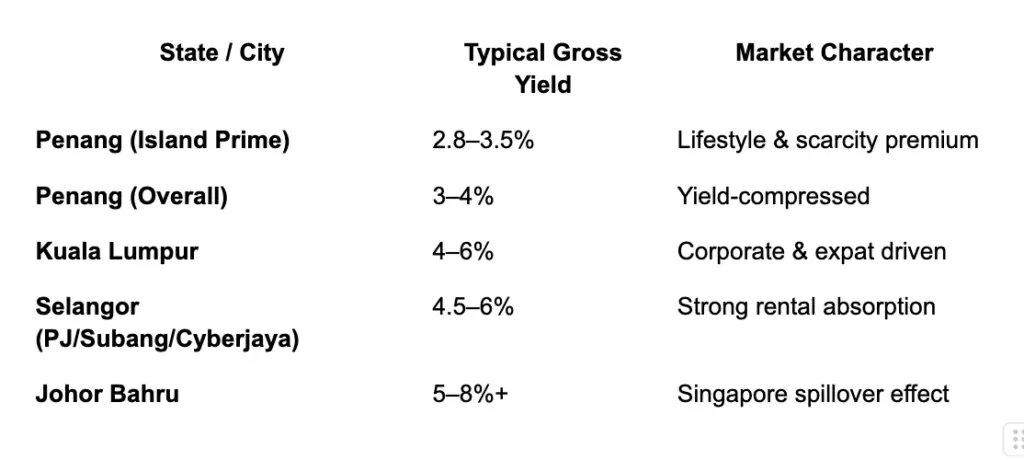
Yet rental yields average only 3–4% gross
Lower yields are not a market weakness. They reflect a structural premium and the type of buyer attracted to Penang.
Rental Yield: Lower Than KL But Backed by Structure
Why it matters: Penang may have lower yields than KL or Johor, but that’s because the market is not primarily rental-driven. Investors pay a premium for limited land, lifestyle, and long-term capital growth, rather than monthly cash flow.
Land Scarcity Creates the Pricing Floor
Geography and zoning limit development:
40–50% of Penang Island is hilly or otherwise unsuitable for building.
George Town heritage zones limit density, preserving cultural value but restricting mass development.
Seafront plots are extremely limited, giving remaining properties a permanent premium.
By contrast, Kuala Lumpur has:
Vast land banks in areas like Cheras, Setapak, Segambut, and Old Klang Road.
Space for high-rise, high-density condos.
Supply pipelines that allow developers to compete aggressively on price.
Impact: Scarcity in Penang creates a natural pricing floor. Prices are defended, even in downturns. KL prices are more sensitive to supply swings.
Supply Structure: Defensive vs Competitive
KL: High-volume launches from 2015–2020 led to oversupply, especially in serviced apartments. Developers competed on price to attract investors.
Penang: Fewer launches, slower approvals, and higher land costs mean supply is tighter. Buyers are more likely to be owner-occupiers or lifestyle-driven investors, rather than short-term yield hunters.
Penang consistently records strong property transaction activity, which is a key indicator of a healthy subsale (secondary) market.
In the first nine months of 2024, Penang recorded 17,801 property transactions worth RM11.53 billion.
Residential properties made up the majority of activity, with 13,210 residential transactions during the same period.
This is significant because most residential transactions in Malaysia occur in the subsale market, meaning completed homes changing ownership between buyers rather than new units directly from developers.
This supports the observation that Penang’s housing demand is largely driven by genuine buyers looking for homes, rather than speculative investors chasing new launches.
Outcome: Penang prices are more resilient during market corrections. Even when Malaysia’s property cycle dips, prime island prices remain stable.
Demand Profile: Lifestyle vs Rental Yield
Kuala Lumpur Buyers:
Mostly corporate tenants and young professionals
Focused on rental yield and monthly cash flow
Sensitive to price competition
Penang Buyers:
Retirees seeking seaside living
Families accompanying long-stay medical tourists
Tech/E&E expatriates
Returning diaspora from Singapore, Hong Kong
Lifestyle investors looking for heritage, coastal views, and long-term stability
Key Point: Penang buyers are less sensitive to short-term yield and more interested in long-term capital growth, lifestyle, and scarcity value.
Capital Appreciation: The Core Investment Thesis
Penang is primarily a capital-growth market, not a yield-first market.
Historical performance:
Prime island projects have appreciated 30–60% over 8–10 years.
Seafront and low-density developments outperform mass-market condos.
Prices rarely crash sharply because land is scarce and demand is consistent.
Summary: Investors accept lower yield (3–4%) in exchange for long-term price defensiveness and lifestyle appeal.
Prime Zones & Pricing Benchmarks
Gurney Drive – The Platinum Mile
Recent prices:
Marriott Residences ~ RM2,000+ psf
Sunrise Gurney ~ RM1,800+ psf
Gurney Paragon & Gurney Ville ~ RM1,200–1,500 psf
Why premium:
Direct seafront frontage
Proximity to hospitals and amenities
Walkable lifestyle
No future large-scale seafront supply
Seri Tanjung Pinang (STP) – Marina Lifestyle
Prices:
Straits Residences ~ RM1,200+ psf
Quayside ~ RM1,000+ psf
STP is Penang’s most established master-planned seafront township, ideal for buyers seeking a marina lifestyle.
Southern Corridor – Bayan Lepas Growth Engine
Prices:
Muze @ PICC ~ RM850–900 psf
QuayWest ~ RM800+ psf
Drivers:
Free Industrial Zone (E&E hub)
Tech and semiconductor expansion
Airport proximity
Mainland bridge connectivity
Yield: Slightly better (~4%), more employment-driven demand.
Airbnb Restrictions: Market Shift
Before the ban: some projects yielded 6–8% via short-term rentals.
After the ban: the market shifted back to long-term tenancy; yields normalized to 3–4%.
Takeaway: Investors now buy primarily for capital growth, not rental cash flow.
Final Summary
Penang property is unique because:
Land scarcity creates a pricing floor.
Lifestyle-driven demand dominates over rental yield.
Rental yield averages 3–4%, lower than KL (4–6%).
Capital appreciation historically strong in prime island zones.