
For decades, standard real estate wisdom advised buying a property, putting up a sign, and securing a single tenant on a standard twelve-month lease. If the tenant paid rent on time and covered the mortgage installment, the investment was deemed a success.
However, today’s shifting economic landscape, fluctuating interest rates, and evolving tenant lifestyles have exposed the vulnerabilities of relying on a single, rigid rental approach.
When an investor relies exclusively on a single family or tenant to cover their entire mortgage payment, any vacancy creates an instant, total loss of rental income. Furthermore, as bank mortgage rates adjust, traditional long-term rents in mature urban centers often struggle to keep pace with rising monthly bank commitments.
To achieve positive cash flow and build long-term wealth, savvy property investors must transition from passive landlords into strategic asset managers. By evaluating and unlocking alternative exit strategies for a single property unit, you effectively build a buffer against market downturns, minimize vacancy risks, and significantly optimize your gross rental yields.
Before committing capital to your next property deal or even when restructuring your current portfolio, it is crucial to understand how diversifying your tenancy models can transform an underperforming asset into a consistent profit generator.
Every residential property possesses unique structural, location, and demographic characteristics. Tailoring the right tenancy strategy to the correct asset type determines whether a property operates at a deficit or delivers surplus monthly dividends.
                               ┌─────────────────────────────────────────────────┐
                               │           PROPOSED RENTAL STRATEGIES            │
                               └───────────────────────┬─────────────────────────┘
                                                       │
         ┌──────────────────┬──────────────────┼──────────────────┬──────────────────┐
         ▼                  ▼                  ▼                  ▼                  ▼
  ┌──────────────┐   ┌──────────────┐   ┌──────────────┐   ┌──────────────┐   ┌──────────────┐
  │  Whole Unit  │   │  Co-Living   │   │   Sublet /   │   │  Short-Term  │   │ Medium-Term  │
  │   Leasing    │   │ Room-by-Room │   │ Master Lease │   │ (Airbnb/STRA)│   │  Corporate   │
  └──────────────┘   └──────────────┘   └──────────────┘   └──────────────┘   └──────────────┘
Below is an analytical breakdown of five core rental mechanisms used by seasoned investors to maximize operational profit.
The traditional long-term lease remains the standard benchmark across the property sector. Under this arrangement, an investor signs over the entire residential layout whether an apartment, condominium, or landed home, to a single party, usually on a one- to three-year tenure.
Co-living splits a residential layout into individual rentable rooms, paired with high-quality shared communal amenities (kitchens, living areas, high-speed Wi-Fi, and laundry facilities). This strategy shifts the focus from leasing total square footage to monetizing spatial utility.
The sublet or master lease strategy involves leasing a residential unit or an entire floor/building to an operational company or master tenant, who then sublets the spaces to end-users. Alternatively, an investor can adopt the operator persona, securing master leases on third-party properties to scale rental inventory without taking on personal property debt.
Leveraging online travel platforms such as Airbnb, Agoda, and Booking.com, short-term rentals convert residential real estate into micro-hospitality assets. Units are leased on a nightly or weekly basis, commanding premium rates during peak travel cycles.
Positioned strategically between traditional long-term contracts and nightly travel stays, medium-term leasing targets contracts ranging from one month to nine months. Properties are fully furnished and tailored for immediate occupancy without requiring long-term commitments.
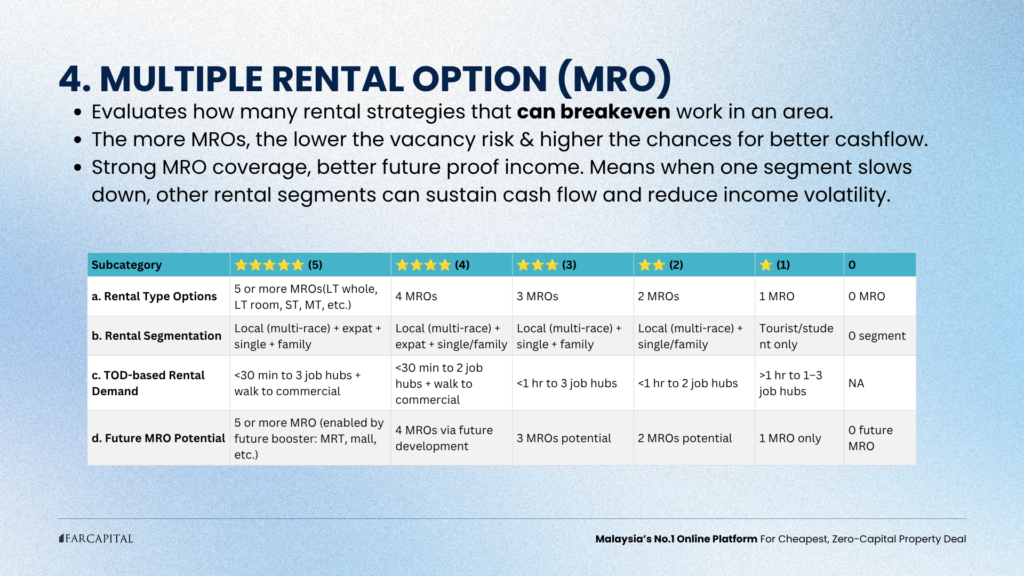
At FAR Capital, property evaluation goes far beyond basic location analysis and purchase price per square foot. The true value and resilience of a real estate asset stem from its inherent adaptability to different leasing strategies. When evaluating prospective deals, we analyze an asset’s exit viability across four essential operational pillars.
To effectively evaluate asset viability before acquisition, property investors should grade prospective developments using the core metrics detailed below:
Operating a profitable property requires matching the right operational layout with your target tenant demographic. Offering an unfurnished whole unit in an urban tech hub saturated with young, mobile professionals will likely lead to prolonged vacancy.
Conversely, converting a spacious family home in a quiet suburban neighborhood into micro-co-living rooms can alienate traditional family tenants while attracting minimal single-room demand.
Investor Pro Tip: Never design a property based on your personal living preferences. Design and optimize strictly for the functional demands and income capabilities of your target tenant demographic in that micro-location.
| Rental Model | Primary Target Demographic | Ideal Location Criteria | Capital Outlay (Fit-Out) | Management Intensity | Yield Potential |
| Whole Unit | Families, Married Couples | Suburban residential areas, near schools | Low | Low | Baseline (Moderate) |
| Co-Living | Singles, Students, Young Pros | Urban commercial centers, near transit stations | Medium – High | Medium – High | High |
| Sublet / Master | Operators, Corporate Firms | High-density employment hubs | Low (for owner) | Minimal (Hands-off) | Fixed (Moderate) |
| Short-Term (STRA) | Tourists, Travelers, Staycations | Tourist zones, city centers, near airports | High | High | Very High (Variable) |
| Medium-Term | Corporate Expats, Contractors | Central Business Districts (CBD), Medical hubs | Medium – High | Moderate | High |
Understanding how economic policy and monetary updates impact tenant buying power and real estate liquidity is equally vital. Investors should regularly track monetary stability updates and policy statements released by primary financial authorities such as Bank Negara Malaysia to anticipate broader market shifts.

The primary hazard in real estate investment is holding an asset with only a single operational exit strategy. When macroeconomic shifts occur such as sudden oversupply in specific apartment segments or localized disruptions in travel and tourism, single-strategy properties often suffer prolonged periods of negative cash flow.
In contrast, properties designed with high exit flexibility easily adapt when market conditions change. If short-term travel demand slows down in a given district, a fully furnished apartment can quickly transition into a medium-term corporate rental or a co-living asset catering to local working adults.
Understanding localized property transactions and market trends through reliable market analytical platforms like EdgeProp Malaysia allows investors to track micro-market changes early. By monitoring real-time transaction prices and regional vacancy shifts, investors can pivot their leasing formats well before market saturation impacts net operating income.
Navigating structural real estate decisions, local municipal guidelines, property management logistics, and building management rules requires strict compliance. For instance, short-term rentals face varying levels of regulation depending on individual municipal rules and Joint Management Body (JMB) bylaws.
Investors who proactively evaluate these operational parameters before acquiring property ensure long-term cash flow stability, safeguarding their investments against unexpected operational disruptions or sudden regulatory changes.
Building a profitable, resilient real estate portfolio requires moving beyond traditional single-tenant leasing assumptions. By analyzing prospective properties through a multi-strategy lens, investors can select assets that deliver strong yields across changing economic cycles.
Whether you choose co-living, medium-term corporate stays, short-term vacation stays, or standard long-term contracts, success ultimately relies on matching the right rental strategy to local demographic demand. Assessing your property’s exit adaptability upfront ensures your real estate investments generate reliable cash flow and long-term capital appreciation for years to come.
Co-living (room-by-room leasing) and short-term rentals (Airbnb) generally offer the highest gross rental yields in urban centers. Co-living provides consistent monthly income by multiplying tenant rent streams within a single layout, whereas short-term rentals maximize revenue per available room night during peak travel seasons.
Properties located within walking distance of major mass public transportation nodes experience consistently higher tenant demand and lower vacancy rates. Transit access allows landlords to command premium rents across all leasing models, attracting working professionals, students, and tourists who prioritize commuting efficiency over vehicle ownership.
Choose whole unit renting if you prefer passive, low-maintenance management with steady long-term tenants. Opt for co-living if your property is located near major employment or educational hubs, and your primary goal is maximizing gross rental income to comfortably surpass monthly bank mortgage payments.
Short-term rental accommodations (STRA) are subject to local state authority guidelines and individual residential building management bylaws. Before listing a property on short-term rental platforms, investors must confirm that the building’s Joint Management Body (JMB) or Management Corporation (MC) permits commercial short-term stays.

