
The landscape of property investment is constantly evolving, and navigating it without a solid framework is a recipe for financial disaster. Many beginners enter the market driven by emotion, purchasing units based on aesthetic appeal or proximity to their childhood homes.
Unfortunately, this emotionally driven approach often leads to negative cash flow, stagnant capital appreciation, and unnecessary stress. To succeed in today’s highly competitive market, you must treat your portfolio like a business.
Every purchase must be calculated, backed by data, and aligned with a clear exit strategy. The days of simply buying a house and waiting for it to double in price are long gone. Today, investors need a systematic, data-driven approach to identify lucrative opportunities that others miss.
If you want to build lasting generational wealth, you must shift your mindset from a casual buyer to a strategic investor. By leveraging proven methodologies and deeply understanding market dynamics, you can drastically reduce your risks while maximizing your returns.
When it comes to building a robust portfolio, defense is just as important as offense. You must have a rigid strategy for buying the best and safest property available on the market.
Avoid purchasing property in Malaysia or anywhere else unless you meet specific, non-negotiable criteria. The biggest mistake you can make is settling for a mediocre deal just because you are eager to get started.
A safe property is one that insulates you from market downturns. It is a property that practically rents itself out, covers your mortgage obligations, and leaves you with surplus cash flow every single month.
To achieve this, you need to remove personal bias from the equation. It does not matter if you personally like the color of the kitchen cabinets or the view from the balcony. What matters is the numbers.
By utilizing comprehensive market data from resources like PropertyGuru Malaysia, you can cross-reference asking prices with actual transaction histories. This ensures you are never overpaying for an asset.
Remember, you make your money when you buy, not just when you sell. If you acquire a property at the right price, with the right fundamentals, your risk of losing capital drops to near zero.
Many beginners struggle for years, trying to figure out the secret formula to real estate success. They read countless books, attend expensive seminars, and still feel paralyzed by analysis paralysis.
However, by following these exact, battle-tested methodologies, you can shortcut the learning curve and position yourself as an instant expert in property within your local market.
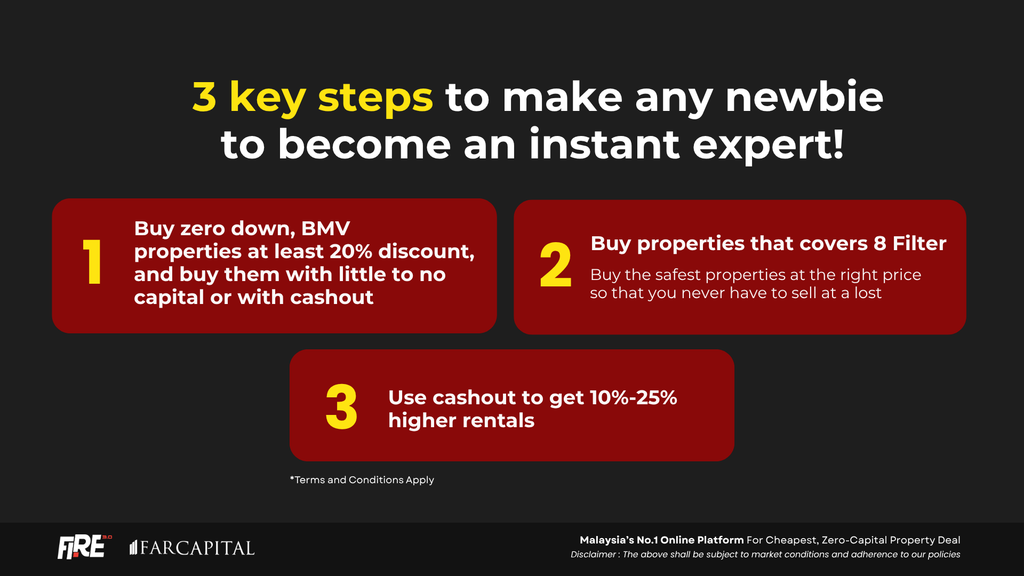
There is no magic pill, but there is a clear, repeatable framework. By mastering three foundational pillars, you can confidently evaluate any deal that crosses your desk in a matter of minutes.
The first step in our proven framework is mastering the art of acquisition. You must aim to buy zero down, Below Market Value (BMV) properties with at least a 20% discount.
Buying BMV means you are acquiring the asset for significantly less than its actual bank valuation. This instant equity acts as a massive safety net. If the market takes a temporary dip, your capital is protected because you bought at such a steep discount.
Furthermore, you should strive to buy these properties with little to no capital, or ideally, with a cashout option. Utilizing a zero-down strategy allows you to preserve your personal savings for emergencies or future investments.
When you combine a 20% discount with a zero-down structure, your return on investment (ROI) skyrockets. You are essentially using other people’s money (the bank’s) to acquire a high-value, income-producing asset.
This requires patience and fierce negotiation skills. You will need to sift through dozens, sometimes hundreds, of listings to find that one golden needle in the haystack. But when you do, the financial rewards are life-changing.
Finding a cheap property is not enough; it must also be a high-quality asset. To ensure you buy the safest properties at the right price so that you never have to sell at a loss, you must run every potential deal through the 8 Property Filters.
1. Price
The entry price must make mathematical sense. It must be significantly lower than the median transaction price for similar units in the immediate area. Overpaying on day one destroys your yield and traps your capital.
2. Booster
A booster is an external catalyst that will drive up the value and rental demand of your property. This could be a newly proposed MRT station, a major highway extension, a new university campus, or a massive commercial development nearby. Boosters guarantee future appreciation.
3. Supply vs Demand
You must understand the micro-economics of the neighborhood. Are there 5,000 new units being handed over next month? If supply heavily outweighs demand, you will face fierce competition for tenants, driving your rental prices down. Always invest in areas where tenant demand outstrips available housing.
4. Multiple Rental Option (MRO)
Never rely on just one type of tenant. A great property offers Multiple Rental Options. Can you rent it out to a family as a whole unit? Can you partition it for students? Can it serve as a short-term Airbnb rental for tourists? Having MRO protects you from vacancy risks if one target market dries up.
5. Cashflow
This is the lifeblood of your portfolio. The monthly rental income must comfortably cover your mortgage, maintenance fees, quit rent, assessment tax, and insurance, while still leaving you with positive cash flow. Negative cash flow is a liability, not an investment.
6. Unique Selling Point (USP)
What makes your unit stand out from the 300 other units in the same building? It could be an unblocked view, a corner lot layout, proximity to the elevator, or two side-by-side parking bays. A strong USP ensures your property gets rented or sold faster than the rest.
7. Return on Capital (ROC)
You must calculate how hard your money is working for you. If you put down RM10,000 and get back RM5,000 in net profit over the year, your ROC is 50%. Always aim to maximize your ROC by keeping your initial capital outlay as low as possible.
8. Multiple Exit Option (MEO)
Before you even buy, you must know how you will exit. Can you sell it to a sub-sale homebuyer? Can you refinance it to pull out equity? Can you sell it en-bloc? Having Multiple Exit Options ensures your money is never permanently trapped in a single asset.
The final step in this trifecta is utilizing the cashout you received during the acquisition phase to drastically improve the asset.
When you buy a property below market value with a high margin of finance, you often receive a cash surplus. Instead of spending this on personal liabilities, reinvest it directly into the property.
Use this cashout to fund strategic renovations, high-quality interior design, and premium furnishings. By elevating the aesthetic and functional appeal of the unit, you can command 10% to 25% higher rentals compared to bare or basic units in the same building.
This strategy allows you to attract premium tenants who are willing to pay a premium price for a move-in-ready, beautifully designed home. It transforms a standard unit into a highly desirable commodity.

Securing above-average rentals is an art form that blends psychology, design, and strategic marketing. Tenants are no longer just looking for a roof over their heads; they are looking for a lifestyle.
To beat the market rate, you must first deeply understand your target demographic. If your property is near a corporate hub, your target audience consists of young professionals. They value high-speed internet, modern minimalist furniture, and a dedicated workspace.
If your property is near a university, students prioritize functional space, durable furniture, and privacy. Tailor your interior design specifically to the desires of your ideal tenant.
Secondly, invest in professional photography. Most investors snap a few blurry photos with their smartphones and upload them to property portals. By hiring a professional real estate photographer, your listing will instantly stand out, attracting more views and higher-quality leads.
Finally, offer excellent service. Treat your prospective tenants like valued clients. Respond to inquiries promptly, be transparent about the terms, and ensure the unit is immaculately clean during viewings. A professional approach justifies a premium price tag.
Achieving a high rental rate is great, but having your property sit empty for three months out of the year completely wipes out your profits. Ensuring consistent tenancy is the true secret to long-term wealth.
The most effective way to keep your properties fully tenanted is by fostering a phenomenal landlord-tenant relationship. When a tenant moves in, provide them with a welcome package. Give them a localized guide detailing the best nearby restaurants, emergency contacts, and public transport routes.
When maintenance issues arise, address them immediately. Do not haggle over a RM50 plumbing fix if it means keeping a tenant who pays you RM2,000 a month perfectly happy. Happy tenants renew their leases, saving you the hassle and cost of finding new ones.
Additionally, stay ahead of the market. Three months before a lease expires, initiate a conversation with your tenant. Offer them a reasonable renewal rate. If they decide to leave, this gives you ample time to market the property and secure a new tenant before the current one even moves out, ensuring zero vacancy days.
For more advanced tactics on building an unbeatable portfolio, check out our guide on the bulk purchase property investment strategy.
BMV stands for Below Market Value. It refers to a property that is available for purchase at a price significantly lower than its current open market valuation by a bank or appraiser. Buying BMV provides instant equity and acts as a buffer against market fluctuations.
In many markets, you can achieve a zero down payment by purchasing a property with heavy developer rebates, negotiating cash-back deals on sub-sale properties, or utilizing specific government homeownership schemes designed for first-time buyers.
Capital appreciation is speculative; you only realize the gain when you sell or refinance. Cash flow, however, is realized every month. Positive cash flow keeps you afloat during economic downturns, pays for your holding costs, and allows you to scale your portfolio safely.
A booster is an infrastructural or commercial development near your property that dramatically increases its desirability. Examples include new train stations (LRT/MRT), mega shopping malls, international schools, or massive corporate business parks.
To minimize vacancy, ensure your property is priced competitively, professionally maintained, and well-furnished. Target the right demographic with tailored interior design, and most importantly, treat your existing tenants exceptionally well to encourage long-term lease renewals.

