
Earning in Singapore Dollars (SGD) while living or investing in Malaysia is one of the most potent financial arbitrage strategies available in Southeast Asia today. For ambitious Malaysian professionals working in the Lion City, your foreign income is not just money to be spent or left sitting in a low-yield savings account.
Instead, it is a high-powered engine capable of unlocking massive leverage through Malaysian property loans.
If you are already aware of the property market’s wealth-building potential, you are likely asking yourself a critical question: How do I bridge the gap between my current salary and a diversified real estate portfolio worth at least RM5 million?
The answer lies in understanding the mechanics of cross-border financing, asset structuring, and banking psychology. By mastering how Malaysian financial institutions evaluate your overseas earnings, you can convert your monthly paycheck into an aggressive, multi-property acquisition plan.

Malaysian banks view Singapore-based earnings through a lens of high reliability and stability. Singapore’s robust economy, strict financial regulations, and strong currency make earners of this income highly attractive credit candidates.
When you apply for a residential or commercial property loan in Malaysia, your SGD income undergoes a currency conversion process that instantly inflates your borrowing capacity relative to local standards. Even after accounting for mandatory bank risk adjustments, your purchasing power remains exponentially higher than that of your domestic peers.
A monthly salary of SGD 6,000 might be considered an average managerial income in Singapore. However, when converted to Malaysian Ringgit (MYR), it represents an income of roughly RM20,000 to RM21,000 depending on prevailing exchange rates.
In the eyes of a Malaysian credit underwriter, you instantly move into the top-tier income bracket, making you eligible for premium loan products, faster approval times, and highly competitive interest rates.
Building a RM5 million property portfolio sounds daunting, but when broken down into strategic, bite-sized acquisitions, it becomes a simple game of leverage and mathematics. You do not need RM5 million in cash; you only need the borrowing capacity to secure RM4.5 million in financing, assuming a standard 90% Margin of Finance (MoF) for your first two residential properties.
To hit the RM5 million mark, a typical portfolio scaler might target one of the following blueprints:
| Property Type Strategy | Number of Units | Average Unit Price | Total Portfolio Value |
| High-Tier Luxury/Commercial | 2 Units | RM 2,500,000 | RM 5,000,000 |
| Mid-Tier Growth Condominiums | 5 Units | RM 1,000,000 | RM 5,000,000 |
| Mass-Market High-Yield Hubs | 7 Units | RM 700,000 | RM 4,900,000 |
For most scalable investors, the Mid-Tier or Mass-Market strategy is ideal because it distributes vacancy risk across multiple tenants and geographic locations, such as Kuala Lumpur, Selangor, and Iskandar Malaysia.

While banks love SGD, they are inherently risk-averse. To cushion against currency volatility and cross-border regulatory shifts, Malaysian banks apply what is known as a “haircut” to your gross foreign income.
What is a Haircut? A haircut is a percentage reduction that banks apply to your overseas income during the loan underwriting process. If a bank applies a 20% haircut, they will only recognize 80% of your total net income when calculating your Debt Service Ratio (DSR).
Understanding how different banks apply this haircut is crucial to maximizing your leverage.
To ensure your loan passes smoothly, make sure your financial documentation aligns with the strict requirements outlined by regulatory bodies like Bank Negara Malaysia, which governs credit lending frameworks across the nation.
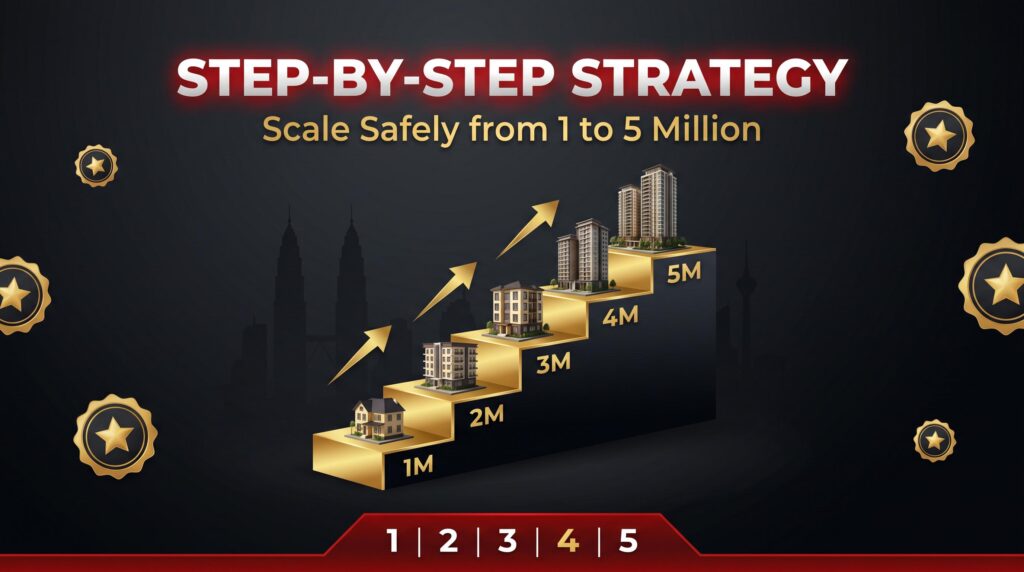
Scaling a portfolio requires moving away from the “one property at a time” mindset. Instead, you must plan your first three moves simultaneously. Here is how to execute this blueprint using your overseas earnings.
Under current Malaysian banking regulations, individuals are entitled to a 90% loan-to-value ratio for their first two residential property loans. Your third residential loan typically drops sharply to 70%.
As a portfolio scaler, your first move should be to acquire two undervalued, high-yield properties concurrently or in quick succession. This locks in maximum leverage while your DSR profile is completely clean.
To bypass the 70% loan restriction on the third property, sophisticated investors utilize multi-submission or compression strategies. This involves submitting loan applications to multiple banks at the exact same time. Because credit reporting bureaus take time to update, banks evaluate each application assuming it is your first or second loan, potentially securing you multiple 90% loans at once.
Note: This technique requires flawless execution, immaculate documentation, and deep relationships with mortgage brokers who understand high-net-worth foreign earner profiles.
Once your personal residential quotas are exhausted, your foreign income can be channeled into a Malaysian Private Limited Company (Sdn Bhd). Commercial properties such as retail lots, industrial warehouses, or corporate offices.
Do not suffer from the residential 70% LTV restriction on the third loan. Banks will evaluate the company’s cash flow alongside your personal guarantee backed by your SGD income.

When you have a strong income currency, it is easy to become overconfident and make mistakes that can permanently stall your scaling journey.
Do not fall into the trap of buying overvalued luxury condominiums that rely solely on future capital appreciation. If a property drains RM2,000 from your pocket every month to cover the mortgage shortfall, your bank will see that as a liability, severely damaging your DSR for the next purchase. Target properties where the rental yield matches or exceeds the mortgage payment.
While the SGD has historically maintained incredible strength against the MYR, macroeconomic conditions can shift. If the Ringgit strengthens rapidly, your converted income value will drop on paper. Always maintain a robust cash reserve—ideally 6 to 12 months of total portfolio mortgage commitments—in a high-yielding offset account.
Managing five or more properties while working full-time in Singapore is a logistical nightmare. Delayed tenant repairs, vacancies, and uncollected rent will quickly derail your momentum. Outsource your operations to professional property management platforms that specialize in maximizing tenant retention and maintaining yield optimization.
Your SGD foreign income is a generational wealth-building tool, but only if it is converted into tangible, cash-generating assets. By structuring your finances correctly, respecting the banking system’s rules, and systematically leveraging your high DSR capacity, a RM5 million property portfolio is entirely within your grasp.
Stop letting your hard-earned cash sit passively. Take control of your scaling journey today by running your numbers through our proprietary assessment tools.
Yes, absolutely. Malaysian citizens earning Singapore Dollars (SGD) can fully utilize their overseas salary, CPF contributions, and IRAS tax statements to apply for Malaysian property loans. Banks will convert the currency and apply a standard risk haircut (usually between 10% to 30%) to evaluate your eligibility.
Malaysian citizens earning overseas income are eligible for a maximum Margin of Finance (MoF) of up to 90% for their first two residential properties. For non-Malaysian citizens or for a third residential property loan onward, the maximum financing typically drops to 70%.
Banks require a comprehensive documentation trail, including:
– The last 3 to 6 months of official payslips.
– The last 3 to 6 months of bank statements showing regular salary credits.
– Your latest Singapore Central Provident Fund (CPF) history statement.
– Your latest Inland Revenue Authority of Singapore (IRAS) Notice of Assessment (Tax Document).
– A valid employment contract or confirmation letter.
Yes. Malaysian banks routinely request your Singaporean credit bureau report (Credit Bureau Singapore – CBS). Any outstanding monthly liabilities in Singapore, such as car loans, personal loans, or credit card balances, will be calculated into your total monthly commitments. Because of the currency conversion rate, even small SGD liabilities can significantly reduce your Malaysian borrowing power.
Disclaimer: The information provided in this article is for educational and informational purposes only and does not constitute formal financial, legal, or investment advice. Loan approvals and banking terms are subject to individual credit profiles and shifting institutional policies.

