
Calculating the true market value price of a property before you sign a booking form is the single most important habit that separates successful investors from broke buyers.
At FAR Capital, we see thousands of eager Malaysians fall into the same exact trap every single year. They walk into a stunning developer sales gallery, get dazzled by air-conditioned showrooms, fall in love with scale models, and sign a booking form on the spot. They pay a booking fee without ever checking if the unit is actually worth the asking price.
If you want to build long-term wealth through real estate, you must eliminate guesswork. You must replace developer hype with undeniable market data.
In this complete guide, you will learn how to use free online platforms like Mudah.my, iProperty, and PropertyGuru to calculate property valuation accurately. You will master the median price formula and learn how to secure the best property deals in Malaysia every single time.

The true market value price is the actual price a willing buyer and a willing seller agree upon in an open, arms-length market transaction, backed by recent historical bank valuation data.
Unlike the listing price on an advertisement banner, the true market value price reflects what the market is actually willing to pay today. Bank valuers do not care about sales brochures, designer lighting, or free kitchen cabinets. They rely on real, transacted prices registered with the government.
If you buy a property above its actual valuation, you are paying out-of-pocket for the difference. When you master how to calculate this metric yourself, you gain immediate negotiation power over sellers and real estate agents.
Developers are in the business of selling future lifestyle promises. To make a project financially profitable, developers often price their new launches based on expected future prices five years from now.
However, if surrounding completed properties sell at RM500 per square foot (PSF), but a developer sells a new launch at RM800 PSF, a dangerous valuation gap exists.
| Property Metric | Completed Sub-Sale Unit | New Launch Developer Unit |
| Pricing Baseline | Current market transacted rates | Projected future rates |
| Valuation Risk | Low (backed by bank records) | High (dependent on future growth) |
| Freebies Included | Negotiable with individual seller | Rebates, legal fees, cash back |
| Immediate Cash Flow | Instant rental yield potential | Zero yield during construction |
If you buy an overpriced unit today, the bank valuer may refuse to match your purchase price when the project completes. This means your bank loan approval percentage drops, forcing you to top up cash unexpectedly. Finding the true market value price protects you from this costly financial trap.

Most beginner property buyers make a common mathematical mistake: they use the simple average price to evaluate an area. Using average pricing is dangerous because extreme values distort the overall picture. One distressed seller dumping a unit cheaply, or one luxury, renovated penthouse listed sky-high, ruins your average calculation entirely.
Average Price Formula = Total Sum of All Asking Prices ÷ Total Number of Properties
Instead, smart property investors rely on the median price. The median is the exact middle point of a gathered set of data points arranged from lowest to highest.
Data Set (PSF): RM350, RM400, RM420, RM450, RM750
- Average PSF = RM474 (Skewed upward by the RM750 outlier)
- Median PSF  = RM420 (Accurate representation of real market baseline)
The median price reveals what typical buyers in that specific neighborhood are paying right now.
Mudah.my is one of Malaysia’s oldest and most active peer-to-peer listing platforms. Because Mudah allows direct owners to list for free or at very low costs, it gives you direct visibility into raw market sentiment and desperate seller behavior.
Here is how to extract raw data from Mudah.my:
Keep in mind that listed prices on Mudah.my are asking prices, not final closed prices. As a general rule of thumb, sellers on Mudah usually accept a final price that is 10% to 15% below their original asking price.
While Mudah gives you raw seller sentiment, iProperty gives you structured agency data. Most real estate agents pay subscription fees to list their properties here, resulting in higher-quality photos and detailed property descriptions.
When using iProperty to determine the true market value price, follow these steps:
If you see 60 identical units listed for sale in the same condominium complex, you know sellers are competing aggressively against each other. This oversupply gives you strong leverage to offer below the median asking price.
PropertyGuru is another essential platform that offers deep comparative market data and analytical toolsets. It is particularly effective for evaluating price trends over a 3-year to 5-year timeline.
Here is how to use PropertyGuru effectively:
If a property’s price graph has remained flat for five straight years, the area suffers from poor capital appreciation momentum. Buying a project in a stagnant zone even with attractive rebates will likely trap your capital for years.
Online portal listings show you what sellers hope to get. To find out what buyers actually paid, you must check official government records. In Malaysia, official transacted records are managed by the National Property Information Centre (NAPIC) under the Valuation and Property Services Department (JPPH).
Asking Price (Portals)  --->  Negotiated Price  --->  Transacted Price (NAPIC Records)
    [Seller's Wish]           [Middle Ground]          [Bank Valuer Standard]
NAPIC data records the actual Stamp Duty transacted values stamped at the Inland Revenue Board (LHDN). Bank valuers use these exact NAPIC transaction numbers when approving loan amounts. When you combine online listing data from property portals with historical NAPIC transaction records, your final calculation of the true market value price becomes bulletproof.
Now that you have gathered your raw data, it is time to run the actual calculation. Follow this straightforward step-by-step formula.
a) Collect 10 Listing PSF values from portals.
b) Apply a 10% negotiation discount to get Estimated Closing PSF.
c) Arrange values from lowest to highest.
d) Pick the middle value (Median PSF).
e) Multiply Median PSF by Target Unit Size (Sq Ft).
Imagine you want to buy a 1,000 sq ft condominium unit in Cheras.
The true market value price for a 1,000 sq ft unit in this building is RM450,000. If the seller or developer demands RM550,000, you are instantly overpaying by RM100,000.
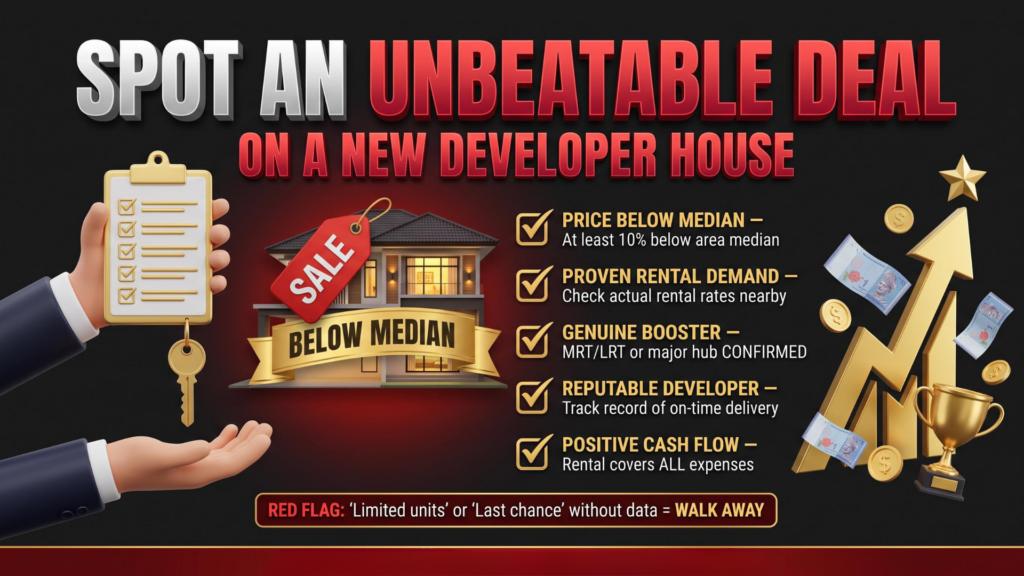
Buying a new developer project is not inherently bad. You can land extraordinary profits if you know how to strip away marketing illusions to find the Net Price. Developers often hide true pricing behind heavy rebates, cash-back incentives, and free packages.
To evaluate a new launch developer unit, follow this verification checklist:
The Golden Rule: If the developer’s Net PSF is equal to or lower than the surrounding sub-sale median PSF, you have found an outstanding deal. Buying a brand-new house at or below the existing market baseline guarantees instant equity gains the moment the project completes.
The property booking form is a legally binding commitment. The moment you sign that document and transfer a booking fee, you surrender your negotiation leverage. Sales agents are trained to create artificial urgency. They will tell you that “only two units are left” or that “the promotion ends today.” Do not fall for high-pressure sales tactics.
[ Research Market Data ] ---> [ Calculate Median PSF ] ---> [ Verify Bank Valuation ] ---> [ Sign Booking Form ]
Always perform your mathematical research before you step into a sales gallery. If you sign a booking form for an overpriced property, getting your refund back can take months of painful paperwork or worse, result in forfeiting your deposit entirely.
If a developer sales representative refuses to give you time to verify the true market value price, walk away immediately. There will always be another deal.
Successful property investment is fundamentally simple: buy below market value, secure positive cash flow, and hold quality assets long-term. When you buy real estate based on hard numbers, you protect yourself against market downturns, high interest rates, and unexpected economic shocks.
Before you buy your next property, take a step back:
When the numbers align, you can sign the booking form with absolute peace of mind, knowing you secured an unbeatable deal. Ready to take your real estate portfolio to the next level? Contact FAR Capital today to consult with our expert property strategists.

