
Usually, a bulk purchase in Malaysian real estate refers to a volume transaction where multiple units are sold simultaneously. Typically, 10 units or more to a coordinated group of buyers or an investment vehicle.
Unlike retail purchases, where buyers negotiate alone, bulk purchase deals leverage collective buying power to unlock wholesale pricing from developers.
According to the Malaysian Institute of Estate Agents (MIEA), the threshold for what constitutes a bulk purchase has shifted with market conditions. During stronger markets, bulk deals required 20–50 units. In the current climate, some developers accept bulk purchase orders as small as 10 units (EdgeProp Malaysia).
However, a bulk purchase does not mean one person buys 10 apartments. It means 10 individual buyers coordinate through an organizer, an investment club, agency, or syndicate to present a unified volume order to the developer.
Each buyer signs an independent Sale and Purchase Agreement (SPA), owns their specific unit, and retains full rights under the Housing Development Act (HDA).

The mathematics of property development explains why bulk purchase groups consistently secure discounts individual buyers cannot match:
| Cost Factor | Individual Buyer | Bulk Purchase Group |
|---|---|---|
| Marketing cost per unit | RM15,000–RM25,000 | Near zero (direct sale) |
| Sales commission | 2–3% of price | Eliminated or reduced |
| Holding cost (unsold units) | Developer absorbs | Minimized via volume sale |
| Cash flow risk | Spread over months | Resolved in single transaction |
| Admin/legal overhead | Per-unit processing | Batch efficiency |
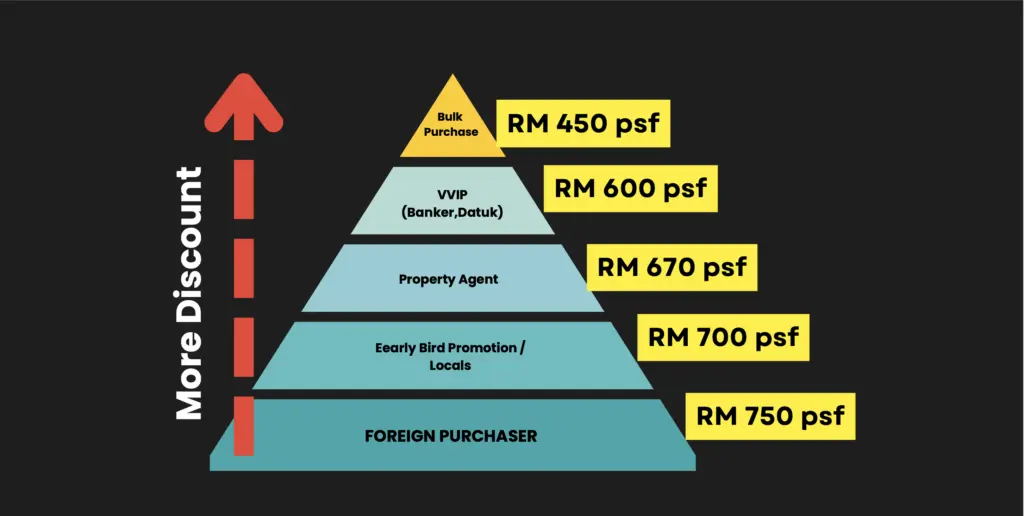
Developers translate these savings into direct price cuts. Bulk purchase discounts in Malaysia typically range from 10% to 25% off list price, with CBD Properties group managing director Datuk Adrian Wang confirming that “buyers and investors will definitely be getting more bulk purchase opportunities in a market slowdown” (EdgeProp).
For a RM500,000 condominium, a 15% bulk purchase discount equals RM75,000 in immediate equity, capital appreciation that normally requires years of market growth to achieve.

Yes. Bulk purchase property transactions are entirely legal in Malaysia. There is no statute prohibiting coordinated group buying, and developers actively welcome volume sales as a strategic revenue tool.
The legal framework:
According to property lawyer Chris Tan of Chur Associates, “An entity such as an individual person, private firm or a limited liability partnership that buys more than four units is considered bulk buying and the developer has to register the sale with the Urban Wellbeing, Housing and Local Government Ministry” (EdgeProp).
Red flags to avoid:

The cornerstone of every bulk purchase deal. Developers apply tiered discounts based on unit quantity. A 50-unit commitment triggers deeper cuts than a 10-unit order.
Groups negotiate creative financing where developer rebates cover the 10% down payment requirement. Buyers enter with minimal capital outlay.
Bulk purchase groups often secure waived legal fees (saving RM3,000–RM8,000 per unit) and stamp duty subsidies, costs individual buyers bear alone.
Developers upgrade tile grades, kitchen cabinet brands, or air-conditioning inclusions for bulk purchase buyers to differentiate the volume deal from retail sales.
Groups secure first pick of floor plans, facing directions, and premium floors before public launch, critical in boutique developments with limited inventory.
Some bulk purchase negotiations extend the standard 24-month structural DLP to 36 months, adding a full year of developer warranty coverage.
Investment clubs often negotiate discounted property management rates for the first 24 months, improving net rental yield for investor buyers.

The barrier to bulk purchase discounts isn’t wealth, it’s network access. Here are four legitimate pathways for individual investors:
Property investment clubs like FAR Capital aggregate individual buyers into collective negotiations. Membership provides access to pre-negotiated bulk purchase deals without requiring multi-unit commitment.
FAR Capital has facilitated transactions for over 29,866 clients with a near-zero non-performing loan rate.
Established agencies like Chester Properties specialize in bulk purchase facilitation. They negotiate on behalf of buyer groups, handling documentation, developer vetting, and rebate structuring. Agency-facilitated bulk buyers typically secure 3% to 5% discounts even in smaller group sizes.
Experienced investors can coordinate private syndicates of 5–10 buyers targeting specific developments. This requires legal structuring to ensure each participant signs an independent SPA and the organizer does not commingle funds.
Sophisticated individual buyers purchasing 5 or more units can approach developers directly. While this requires substantial capital, the bulk purchase rebate structure applies equally to single-entity volume buyers.
Important: Solo buyers should never transfer funds to an organizer’s personal account. All payments must flow directly to the developer’s project account or through a lawyer’s stakeholder arrangement.

MIEA national vice-president Lim Boon Ping cautions that bulk purchase deals carry risks individual buyers rarely consider (EdgeProp):
In a bulk purchase group, every member must secure financing. If one buyer’s loan is rejected, the group must find a replacement or renegotiate the entire deal. Failure to resolve this within the agreed timeframe can result in deposit forfeiture.
Discounted properties in bulk purchase deals may sit in oversupplied or poorly connected locations. As Datuk Adrian Wang warns: “You can buy a property at a lower price today, but you might lose more in the future because there could be other possibilities behind the cheaper prices.”
Some developers inflate list prices before applying bulk purchase “discounts,” creating artificial savings. Always cross-reference the post-discount price against comparable units in the area.
Certain bulk purchase agreements include lock-in periods (12–24 months) preventing immediate resale. This impacts investors seeking quick capital rotation.
FAR Capital operates one of Malaysia’s most transparent bulk purchase frameworks. Rather than opaque fund pooling, their model connects individual investors to developer volume deals through structured SPAs.
How it works:
Key statistics:
This model demonstrates that bulk purchase strategies are not reserved for institutional investors—they are accessible to retail buyers through the right organizational structure.
No. While direct multi-unit buying requires significant capital, joining an investment club allows retail buyers to access bulk purchase pricing with standard single-unit budgets.
Yes. In properly structured bulk purchase deals, each buyer selects their preferred unit, floor, and facing before SPA execution. You are not assigned a random unit.
Legitimate bulk purchase discounts reflect real developer cost savings. However, buyers must verify that the discounted price aligns with market comparables, not an inflated list price with a fake markdown.
Yes. When each participant signs an individual SPA, all Housing Development Act protections apply: LAD claims for delayed VP, 24-month structural DLP, and defect rectification rights.
If you’re purchasing property in Malaysia as an individual buyer, you’re likely overpaying by 10–15% without realizing it. The bulk purchase market isn’t a closed club, it’s an open strategy requiring the right access point.
Start by evaluating licensed investment clubs with transparent fee structures and individual SPA policies. Verify developer credentials through KPKT’s licensing database. And always cross-reference the “discounted” price against actual transacted data in the area.
The question isn’t whether bulk purchase works. The question is whether you’ll keep paying retail prices while others buy wholesale.

