
The Klang Valley has long been Malaysia’s economic and property heartland, encompassing Kuala Lumpur, Petaling Jaya, Subang Jaya, Cheras, Puchong, Shah Alam, and surrounding urban centres. For investors and homeowners alike, understanding rental yield patterns is key to making smart property decisions.
While location is always crucial, recent market trends indicate that the number of bedrooms in a unit can be just as decisive for rental yield returns.
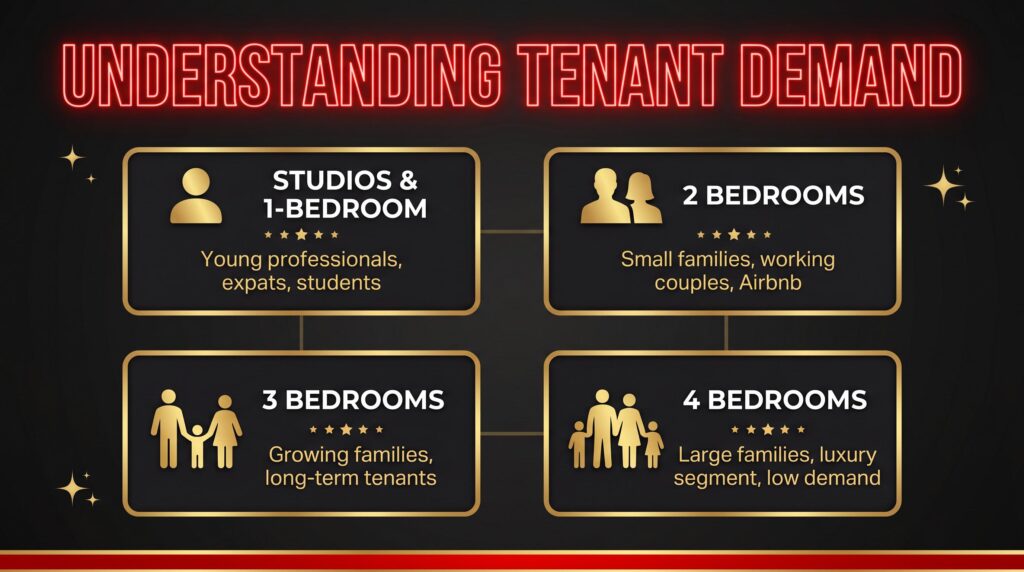
Different unit sizes attract distinct tenant segments:
Investors who understand this hierarchy can strategically balance cash flow needs with long-term capital appreciation.
Data across the Klang Valley consistently show that rental yield decreases as bedroom count increases. Three main factors drive this pattern:
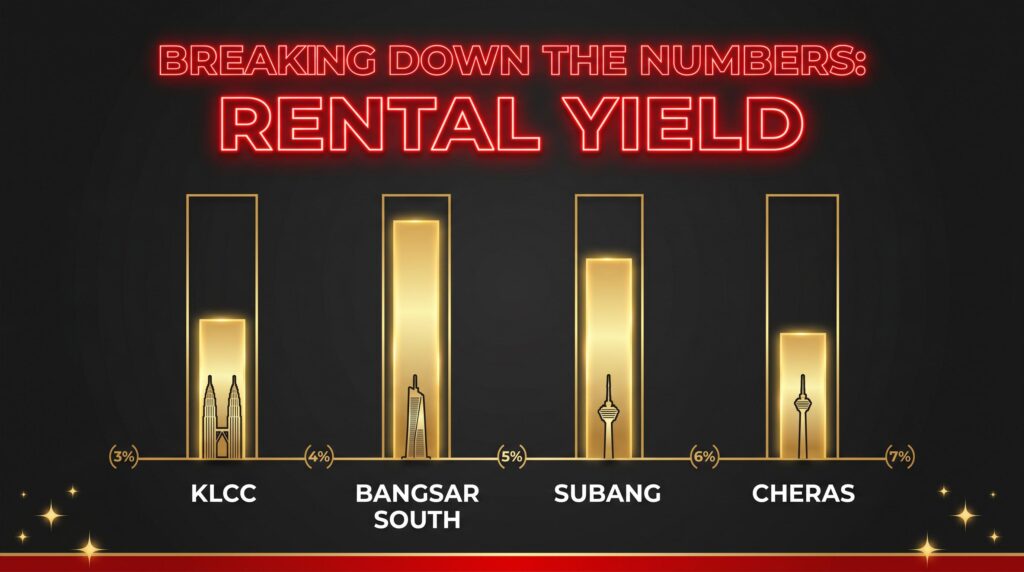
Compact units consistently offer the highest rent-to-price ratio, especially near transport hubs or business districts.
Advantages:
– Lower entry price makes them accessible to investors with limited capital
– Strong demand among singles and expatriates ensures higher occupancy rates
– High rental mobility allows investors to adjust rents frequently with market trends
Challenges:
– Higher tenant turnover compared to larger units
– Increased competition from newly launched projects
– Sensitive to market cycles
Market Examples:
| KLCC / Bangsar: RM3,500–RM5,000/month |
| Subang: RM1,800–RM2,200/month |
| Bangsar South: RM2,300–RM3,000/month |
Two-bedroom units strike a balance between rental yield and demand stability, appealing to both small families and sharers. Investors favor these units because they reduce vacancy risk while still offering attractive rental returns.
Market Examples:
| – Kuala Lumpur (average city): RM3,400/month | – KLCC / Bangsar South: RM4,500–RM6,500/month |
| – Subang: RM2,500–RM3,200/month | – Cheras: RM2,500–RM3,500/month |
These units are particularly resilient during market fluctuations, making them a favourite for both first-time investors and those building a rental portfolio.
3. Three-Bedroom Units: Family-Oriented
Three-bedroom properties cater primarily to families who prefer long-term rentals or home ownership, leading to lower turnover but also moderate rental yields.
Yield characteristics:
– Typically 4.0–5.5% depending on location
– Families are more likely to purchase than rent
– Larger purchase prices relative to achievable rents
Market Examples:
| – KLCC: RM7,500–RM9,000/month | – Subang: RM3,000–RM3,800/month |
| – Bangsar South: RM4,800–RM6,000/month | – Cheras: RM3,000–RM3,800/month |
Investor Note: While rental yields are slightly lower than smaller units, capital stability is stronger, especially in family-centric areas.
Four-bedroom units are the largest, most premium segment of high-rise apartments, often prioritizing space, comfort, and lifestyle over rental returns.
Characteristics:
Market Examples:
| – KLCC: RM9,500–RM12,000/month | – Subang: RM3,800–RM5,000/month |
| – Bangsar South: RM6,000–RM8,000/month | – Cheras: RM3,500–RM4,500/month |
Globally, this mirrors urban trends where large premium units prioritize lifestyle and long-term capital appreciation over rental efficiency.
| Bedroom | KLCC Rent (RM) | KLCC Yield (%) | Subang Rent (RM) | Subang Yield (%) | Bangsar South Rent (RM) | Bangsar South Yield (%) | Cheras Maluri Rent (RM) | Cheras MaluriYield (%) |
| 1-Bed | 3,000–4,500 | 4.5–5.2 | 1,800–2,200 | 5.5–6.0 | 2,300–3,000 | 5.3–6.0 | 1,700–2,300 | 5.5–6.5 |
| 2-Bed | 5,500–6,500 | 4.2–4.8 | 2,500–3,200 | 4.8–5.5 | 3,000–4,500 | 4.8–5.5 | 2,500–3,500 | 5.5–6.0 |
| 3-Bed | 7,500–9,000 | 3.8–4.2 | 3,000–3,800 | 4.0–4.5 | 4,800–6,000 | 4.0–4.5 | 3,000–3,800 | 5.5–6.0 |
| 4-Bed | 9,500–12,000 | 3.5–4.0 | 3,800–5,000 | 3.5–4.2 | 6,000–8,000 | 3.5–4.0 | 3,500–4,500 | 4.0–4.5 |
Observation:
| Unit Type | Investment Character |
| Studio / 1-Bed | Highest yield, higher turnover, less ownstay |
| 2-Bedroom | Best balance of yield and demand, new ownstay trend |
| 3-Bedroom | Family stability, moderate yield, ownstay mixed |
| 4-Bedroom | Lifestyle ownership, lowest yield, Ownstay mainly |
For investors and homeowners in Klang Valley, the rule of thumb is clear: bedroom count matters as much as location. Compact units deliver better cash flow, while larger homes offer security and capital appreciation over the long term.

