
The 3 stages of property investment provide a clear, battle-tested framework for turning everyday salary earners into financially free real estate investors. Many beginners fail in real estate because they buy the wrong asset at the wrong phase of their personal balance sheet.
Property investment is not a lottery ticket, nor is it a one-size-fits-all product. When executed methodically through the FAR Capital methodology, real estate acts as a progressive engine: first stabilizing your liabilities, next replacing your active income, and ultimately building generational wealth.
If your goal is financial independence, you must align your current financial reality with the right property deal type.
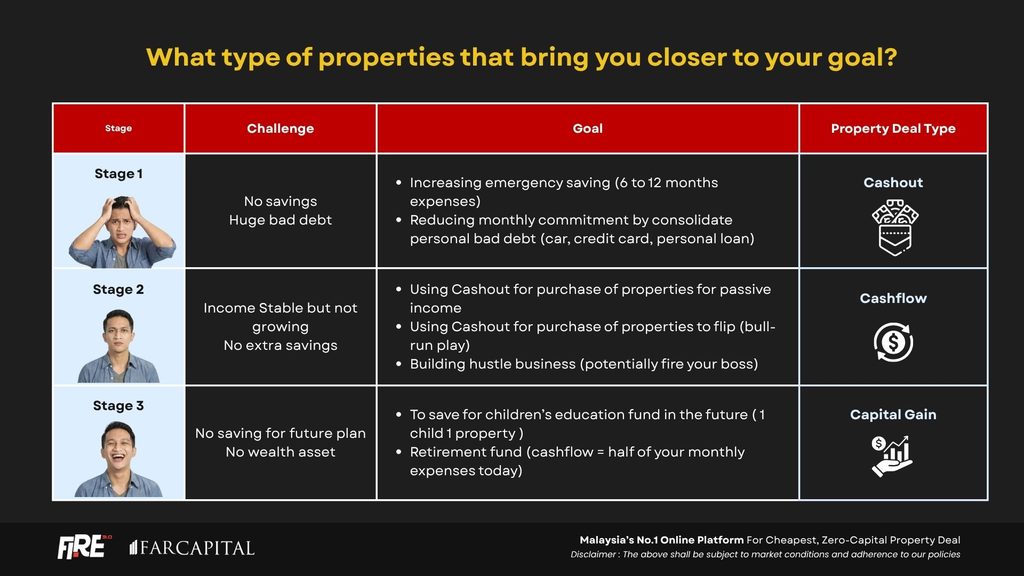
Stage 1: Cashout (Reset) ──> Stage 2: Cashflow (Acceleration) ──> Stage 3: Capital Gain (Legacy)
Most Malaysian property buyers begin with an emotional premise. They search for a property they personally love, stretch their debt-service ratio (DSR) to the limit, and commit to a 35-year mortgage that bleeds their monthly savings.
Traditional advice encourages buyers to save for years to assemble a 10% down payment. However, runaway home price growth and persistent living costs frequently outpace modest salary increments.
When retail investors jump into speculative capital appreciation deals without liquid reserves or cash flow buffers, a single vacancy or an unexpected interest rate adjustment by Bank Negara Malaysia (BNM) can trigger acute financial distress.
True property mastery requires understanding the 3 stages of property investment. You do not buy for prestige; you buy to solve your immediate financial bottlenecks.

Stage 1 Profile:
• Challenge: Zero savings, overwhelming bad debt (credit cards, personal loans, high car installments)
• Strategic Goal: Build 6–12 months of emergency savings; slash total monthly debt commitments
• Targeted Deal Type: Cashout Properties (Below Market Value)
The average middle-income professional in Malaysia carries multiple high-interest, short-tenure consumer liabilities. These typically include personal loans with 6% to 10% flat interest (effective rates exceeding 12%), credit card balances accumulating 18% per annum, and hire-purchase car loans eating RM1,200 to RM2,500 every month.
Even with a combined household income of RM8,000 to RM12,000, high monthly commitments keep your net disposable cash close to zero. In this position, buying an expensive conventional property with negative cashflow is financial suicide.
In Stage 1 of the 3 stages of property investment, your sole priority is a balance-sheet reset. You need an asset that generates upfront liquidity rather than demanding upfront capital.
Through FAR Capital’s bulk negotiation model, properties are acquired 20% to 30% below verified bank market valuation. This valuation gap enables a structured Cashout Deal:
This cashout capital is not free money for consumer splurges. It serves two non-negotiable financial mandates:
Once your monthly cash flow is freed from high-interest debt and your financial emergency fund is fortified, your risk profile stabilizes. You have graduated from Stage 1.

Stage 2 Profile:
• Challenge: Stable income with flat career growth; limited ability to scale savings
• Strategic Goal: Deploy capital into passive income, execute bull-run flips, build side hustles
• Targeted Deal Type: Cashflow Properties (High-Yield & Co-Living Formats)
At Stage 2, your personal balance sheet is clean. You have eliminated toxic debts and hold a dependable cash cushion. However, you face a new problem: your salaried income has plateaued, and inflation continues to erode your purchasing power.
You cannot reach early retirement solely by clipping coupons or saving RM1,000 a month. You need active capital deployment.
Stage 2 turns property into a recurring income engine. The objective here is identifying properties where total rental collections substantially exceed the combined monthly mortgage, maintenance fees, sinking fund, and management overhead.
Within the 3 stages of property investment, Stage 2 relies on two primary mechanics:
Standard long-term tenancy leases in urban Klang Valley or Johor Bahru rarely yield above 3.5% to 4.2% gross, which barely covers a 4.1% home loan. Stage 2 investors optimize unit layouts for high-density co-living models near major commercial hubs, transit lines (LRT/MRT), or tertiary universities.
Stage 2 investors also utilize pre-negotiated entry pricing to position for short-to-medium-term flips during market upswings. By buying into early-phase master developments at 20% below market value, you lock in equity from day one.
When the project completes and the surrounding infrastructure matures, the property can be disposed of or refinanced to harvest five-to-six-figure windfalls.
The net cashflow and harvested capital from Stage 2 are systematically directed toward:

Stage 3 Profile:
• Challenge: Insufficient capital for children's future education; absent wealth-transfer vehicles
• Strategic Goal: Secure 1 property per child for future tertiary funding; fund lifelong retirement
• Targeted Deal Type: Capital Gain Properties (Prime Landed, Tier-1 Transit Hubs)
When you reach Stage 3, your monthly cashflow is sound, your basic living expenses are covered by passive income, and your personal debt is zero. Your focus shifts from daily survival to generational wealth preservation.
The primary hazards at this phase are inflation, educational cost inflation, and outliving your retirement savings. Relying solely on mandatory pension savings like the Employees Provident Fund (EPF) often falls short of maintaining your current standard of living over a 25-year retirement horizon.
In the final phase of the 3 stages of property investment, rental yield takes a secondary seat to scarcity, unrepeatable location, and land value appreciation.
Stage 3 investors deliberately allocate capital into:
Long-Term Appreciation Engine:
Scarcity of Prime Land + Rising Replacement Construction Costs = Compound Capital Growth
Stage 3 transforms real estate into family security via two structural pillars:
Tertiary education costs, especially overseas or at premium private institutions, escalate at 6% to 8% annually. Rather than locking hundreds of thousands of ringgit into low-yield savings accounts, Stage 3 investors purchase one targeted prime property per child early in their life.
Over an 18-to-20-year horizon, tenant rentals pay down the mortgage principal while the property steadily appreciates. When your child turns 18, you have two clear exit strategies:
To secure true retirement independence, your property portfolio must generate steady cash payouts equal to at least 50% to 100% of your current monthly living expenses, completely independent of government assistance or active labor. Because Stage 3 assets sit on prime, low-depreciation land, they form an inflation-proof family trust foundation for generations to come.
To determine where you stand right now, review how the 3 stages of property investment align with your immediate balance sheet requirements:
| Investment Dimension | Stage 1: The Reset | Stage 2: The Acceleration | Stage 3: The Legacy |
| Current Challenge | No savings; heavy bad debt burdens | Flat salary; zero investment surplus | Lack of long-term assets & education funds |
| Primary Goal | 6–12 months emergency savings; debt relief | High passive income; venture seed capital | Child education fund; retirement security |
| Property Deal Type | Cashout Deals (BMV) | Cashflow Deals (Co-Living / Yield) | Capital Gain Deals (Prime Landed / TOD) |
| Key Metric to Watch | Total debt reduction; net cash extracted | Net rental yield; monthly cash surplus | Compound annual growth rate (CAGR); equity |
| Exit / Payoff Horizon | Immediate upon project handover (1–3 years) | Medium-term cash generation (3–7 years) | Long-term generational holding (10–25 years) |
| Emotional State | Stressed, constrained, high liability[cite: 1] | Optimistic, building momentum[cite: 1] | Confident, secure, forward-looking[cite: 1] |
The biggest mistake retail investors make is executing the right strategy at the wrong time
Imagine a young professional with RM5,000 in savings and RM35,000 in combined credit card and car debt. Enticed by glossy brochures, they purchase an RM800,000 suburban landed property hoping for capital gain (Stage 3).
The immediate consequences of this sequence error are severe:
You cannot run a Stage 3 wealth preservation playbook on a Stage 1 foundation. If you carry expensive consumer debt, your first and only real estate objective is a Stage 1 Cashout to stabilize your balance sheet.

Navigating the 3 stages of property investment on your own as an individual retail buyer is uphill work[cite: 1]. When you negotiate with developers alone, you pay full market retail pricing, swallow high transaction fees, and receive standard commercial loan terms.
FAR Capital levels the playing field through our proprietary Data-Aggregated Community Buying Strategy.
Individual Buyer: Buys 1 Unit ──> Pays Full Retail Price ──> Absorbs All Risk
FAR Capital Pool: Combines 50+ Buyers ──> Unlocks 20%-30% Bulk Discounts ──> Zero-Down Entry
By pooling dozens of pre-screened buyers into single high-conviction developments, FAR Capital secures wholesale commercial concessions previously reserved for institutional funds:
Whether you need a Stage 1 cashout to eliminate car and credit card obligations, a Stage 2 property to replace your monthly salary, or a Stage 3 anchor property for your children, our data-backed methodology matches your profile with absolute precision[cite: 1].
Take Action Today: Stop guessing your next property move. Complete your complimentary FAR Capital Financial Screening to evaluate your borrowing profile and unlock curated Below Market Value opportunities.
A cashout property is acquired at a significant discount (typically 20% to 30%) below verified bank valuation. The bank finances the purchase based on valuation, releasing surplus cash back to the buyer upon completion.
This low-interest mortgage capital is then deployed to pay off high-interest unsecured debts like credit cards (18% p.a.) and personal loans (10%+ effective rate), slashing total monthly debt commitments.
Beginners should avoid starting at Stage 3 if they hold existing consumer debts or lack substantial cash reserves. Stage 3 properties (such as premium landed homes or luxury units) often carry lower initial rental yields and higher absolute monthly mortgages.
Without positive cashflow or an emergency safety net, any vacancy or economic downturn can cause severe financial strain.
Through structured group bulk purchases and government-supported housing frameworks, salaried professionals with a gross monthly income starting from RM3,500 to RM5,000 can begin investing, provided their credit history (CCRIS) is properly structured.
FAR Capital conducts comprehensive financial profiling to determine exact bank loan eligibility before selecting any property deal.
The “1 Child 1 Property” strategy is an educational funding method executed in Stage 3. An investor acquires a prime, well-located property early in a child’s life. Over an 18-to-20-year horizon, rental payments amortize the mortgage loan while the property appreciates in market value.
When the child is ready for university, the asset can be liquidated or refinanced to pay for full tuition fees without dipping into retirement capital.
Disclaimer: Real estate investments are subject to market conditions, lender approval, and individual financial profiles. All financial restructuring strategies must be executed in compliance with local banking regulations and verified legal documentation.

