
If you have been scrolling through social media feeds, attending weekend property launch events, or conversing with real estate agents recently, you have undoubtedly been bombarded by an array of incredibly enticing advertisements.
As incredibly appealing as these promotional slogans sound, they frequently conceal a much darker financial reality for the uneducated buyer. We are currently navigating a highly complex landscape. There is a massive abundance of supply, and many property developers are working overtime to clear their unsold inventory.
In their desperation to move units, the marketing tactics have evolved from simple discounts to elaborate financial engineering designed to make you feel like you are winning the lottery.
At FAR Capital, we believe in stripping away the marketing fluff and looking purely at the numbers. In this guide, we will break down exactly how these cashout (cashback) schemes are engineered, why they are often mathematical traps, and how you can bypass the noise to secure truly undervalued properties.
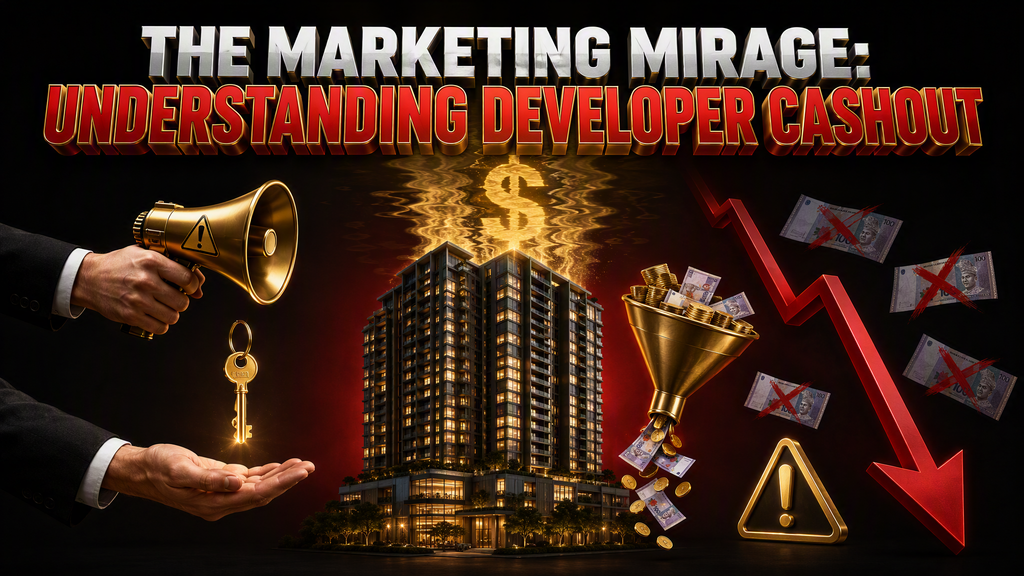
Let us break down the illusion of the modern developer rebate. To understand why developers offer massive cashout, you first need to understand their core objective: maximizing the Gross Development Value (GDV) on paper while clearing physical inventory.
Imagine a developer who has built an apartment complex. Based on their actual construction costs, land acquisition, and required profit margin, they need to sell a standard unit at RM400,000 to remain profitable.
However, some developers know that retail buyers love a “good deal.” Furthermore, they know that many retail buyers are struggling to come up with the upfront cash required for a traditional 10% downpayment, let alone the legal fees and stamp duties.
So, what is their solution? They artificially inflate the Sales and Purchase Agreement (SPA) price. Instead of listing the unit at RM400,000, they list the SPA price at RM500,000. They then proudly announce a massive 20% rebate to the public.
Let us look at a hypothetical investor named Ali who falls for this marketing strategy. Ali sees a property listed at RM500,000 with a 20% rebate. The developer tells him he needs zero downpayment and will even receive RM50,000 cashout upon vacant possession. Ali thinks he has struck gold.
Here is what actually happens to Ali financially. Because the SPA price is RM500,000, the bank issues a 90% loan based on that artificially inflated figure. Ali’s total loan amount becomes RM450,000.
The developer takes the RM450,000 from the bank. They keep their required RM400,000 (their actual target selling price), and they give Ali RM50,000 back in cash.
Ali is thrilled. He buys a new car with his RM50,000 cashout. However, Ali is now servicing a loan of RM450,000 on an asset that is realistically only worth RM400,000 in the open secondary market. He has instantly placed himself in a position of negative equity.
If Ali loses his job in two years and needs to sell the property urgently, he will find that secondary buyers are only willing to pay RM400,000 for it. Since his outstanding bank loan is still hovering around RM430,000, Ali cannot sell the property without topping up RM30,000 of his own money just to clear the debt.
This is not investing. This is a high-interest personal loan disguised as a property transaction.
Contrast Ali’s situation with a genuine Below Market Value (BMV) asset acquisition. A true BMV deal means you are purchasing the asset at a price significantly lower than what a willing buyer would realistically pay a willing seller in the open secondary market today.
A genuine BMV calculation relies heavily on formal bank valuations from independent, recognized valuers, not the marketing brochure of a developer. Furthermore, it relies on recent transaction data from the exact same area, comparing identical layouts and square footage.
If the banks value a specific condominium unit at RM500,000 based on the last five transactions in that building, and you manage to acquire a distressed unit from a motivated seller for RM380,000, you have secured a genuine BMV deal. You have instant equity on day one.

Let us introduce Investor Siti. Siti ignores the flashy developer showrooms and instead focuses her attention on the secondary market and specialized bulk purchase groups.
Siti finds an owner who is migrating overseas and needs to liquidate their asset immediately. The bank valuation for the unit is firmly established at RM400,000. Because the seller is desperate for liquidity, Siti negotiates a hard purchase price of RM320,000.
Siti secures a 90% loan based on her purchase price, meaning her loan is RM288,000. She puts down her 10% deposit of RM32,000.
Unlike Ali, Siti is instantly RM80,000 in the green. If she encounters an emergency next year and needs to sell, she can easily list the property at RM380,000 (still slightly below market value for a quick sale), clear her loan of RM280,000, and walk away with nearly RM100,000 in cash. Siti’s risk is practically nonexistent compared to Ali’s.
To find true hidden gems in the real estate sector, you must completely ignore the developer’s beautifully printed marketing brochures, disregard the aesthetically pleasing showroom interior designs, and look strictly at the raw data.
First, you must conduct a rigorous Comparative Market Analysis (CMA). A proper CMA requires looking at actual, stamped, and finalized transaction data. You should never rely on asking prices listed on property portals, as asking prices are simply an owner’s wishful thinking. A property is only worth what someone has actually paid for it.
You should leverage authoritative primary sources to cross-check this data. We strongly recommend regularly reviewing the official transaction records published by the National Property Information Centre (NAPIC).
NAPIC provides the most accurate reflection of the Malaysian property landscape, detailing the exact prices properties have transacted for in any given quarter.
Secondly, consider the true brick-and-mortar replacement cost. If a developer were to buy the land and construct the exact same building today, how much would it cost them per square foot?
If you are buying a secondary market unit at a price per square foot that is significantly lower than current construction costs, you are heavily insulated against downside risk.
Another excellent method for cutting through the marketing noise is to calculate the Gross Rental Yield of the asset. Cash flow does not lie. Developers can artificially inflate SPA prices, but they cannot artificially inflate the free market rental rates.
Tenants do not care what you paid for the property. Tenants only care about the location, the amenities, and the condition of the unit. The rental market is a brutal, efficient mechanism of true supply and demand.
If a developer is selling a unit for RM600,000, but identical units in the area are only renting out for RM1,500 per month, the gross yield is a mere 3%. This is a terrible investment. The rental income will not even cover your monthly mortgage installment, let alone maintenance fees, quit rent, assessment tax, and insurance.
A genuine below market asset will usually present a much healthier rental yield, often exceeding 5% or 6%, simply because your entry price (the denominator in your yield equation) is so remarkably low.
Positive cash flow is the ultimate defensive strategy in property investment. If your property pays for itself every month, you can comfortably hold it through any market downturn.

At FAR Capital, we do not guess, we do not speculate, and we certainly do not rely on developer cashbacks to make the numbers work. We rely on economies of scale.
When a retail buyer approaches a developer, they are buying a single unit. Their negotiating power is virtually zero. The developer dictates the terms, the price, and the rebate structure.
However, when an institutional buyer or a structured consortium approaches a developer with the intent to purchase fifty or one hundred units simultaneously, the entire dynamic shifts. This is the core of our bulk purchase property investment strategy.
By aggregating the buying power of our extensive client base, we negotiate directly with developers to bypass the inflated SPA prices entirely.
We strip out the marketing costs, the agent commissions, and the fake rebate buffers. We secure prices that reflect the true wholesale value of the real estate, ensuring our clients enter the market with genuine equity from the very first day.
Navigating the real estate market requires extreme caution, a firm grasp of mathematics, and a complete removal of emotional decision-making. The current market is heavily saturated, meaning developers will continue to invent increasingly complex rebate structures to attract uneducated capital.
Remember the core differences we have outlined today. A fake rebate inflates your loan, places you in negative equity, and artificially boosts the developer’s profit margin at your direct expense.
A genuine discounted asset, supported by independent bank valuations and localized transaction data, provides immediate safety, structural equity, and superior rental yields.
Do not be the retail buyer who funds a developer’s marketing budget. Educate yourself, leverage primary data sources, and consider utilizing collective buying power to secure wholesale prices.
Real wealth is created when you buy right, not when you receive a temporary cashback.

