The “Property Plateau”: Most Malaysians Get Stuck At 3 Properties Forever
Hajar Abdullah
May 21st, 2026
The Paradox of the High-Earning Malaysian Investor
Property portfolio expansion is a primary wealth-building milestone for elite Malaysian professionals. You earn a comfortable monthly income of RM10,000 or more. Your credit history is pristine. You have spent years learning about the property market, tracking rental yields, and calculating capital appreciation.
You easily secured financing for your first home, and your second investment property followed shortly after. Then, you hit the invisible wall.
When you apply for your third or fourth mortgage, the bank rejects your application or demands a downpayment so steep it wipes out your liquidity. This phenomenon is known as the “Property Plateau.”
It is the exact point where traditional wealth strategies fail, leaving thousands of ambitious local investors stuck with just two to four mid-range units.
Despite having an excellent salary, you find yourself maxed out by traditional banking frameworks. Your assets are barely breaking even, your Debt Service Ratio (DSR) is choked, and your dream of building an RM3M+ property portfolio for a rental-covered retirement feels entirely out of reach.
To break through this bottleneck, you must understand the systemic banking realities and structural flaws that stop high earners from scaling. Here are the five brutal reasons why most Malaysians get stuck at three properties forever and the advanced mechanisms required to bypass them.
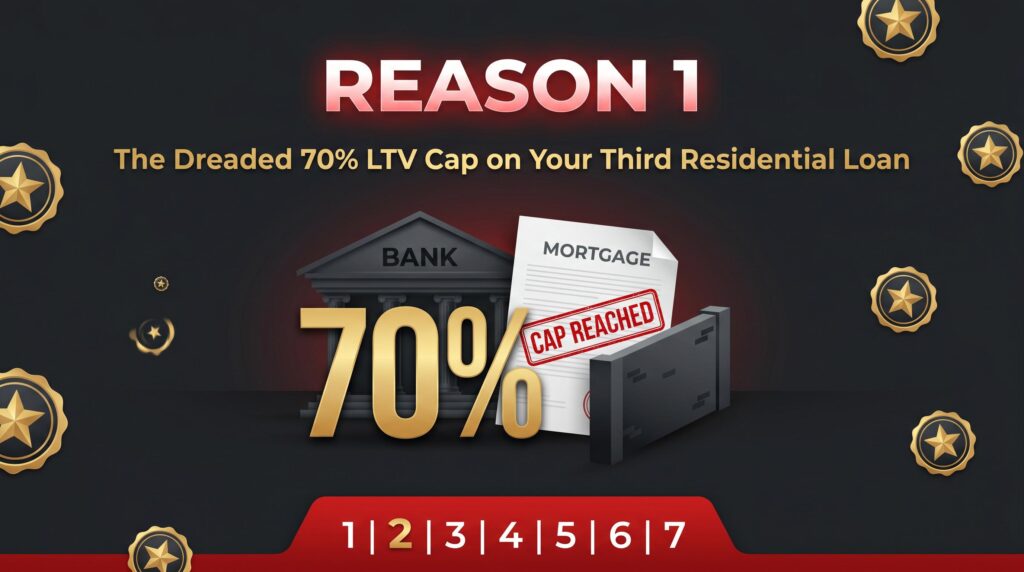
Reason 1: The Dreaded 70% LTV Cap on Your Third Residential Loan
The most immediate and aggressive barrier to scaling a residential property portfolio in Malaysia is Bank Negara Malaysia’s (BNM) macroprudential policy regarding Loan-to-Value (LTV) limits.
For your first two residential property loans, Malaysian commercial banks are generally permitted to offer up to a 90% margin of finance. This means your upfront capital requirement is limited to a 10% downpayment, plus standard entry costs like legal fees, valuation fees, and stamp duties (MOT).
However, the moment you apply for your third residential housing loan, the maximum allowable financing drops sharply to 70% LTV.
The Mathematical Reality of a 70% LTV Cap
Consider a mid-range investment property valued at RM600,000.
At a 90% LTV, your required downpayment is RM60,000.
At a 70% LTV, your required downpayment skyrockets to RM180,000.
When you add approximately 5% to 7% for legal fees, stamping, and basic furnishing, your total cash outlay exceeds RM210,000 for a single property.
Even with an income of RM10,000+ per month, saving an additional RM200,000 in liquid cash while maintaining your current lifestyle and servicing existing debts can take years. This single structural regulation halts portfolio growth for unprepared investors.
Reason 2: The Phantom Menace of Negative Cash Flow
Many mid-range condos across the Klang Valley, Johor Bahru, and Penang suffer from stagnant rental yields. Investors who buy units priced between RM400,000 and RM600,000 often find themselves in a dangerous situation: their properties are barely breaking even, or worse, running on negative cash flow.
The Cost of Negative Cash Flow: If your monthly mortgage payment is RM2,500, maintenance fees are RM350, and your tenant pays RM2,200, you are losing RM650 out of pocket every single month.
While an individual losing RM650 a month might seem manageable on an RM10k salary, the true damage is not to your wallet, it is to your borrowing profile.
When you apply for a new loan, banks do not look at your properties as noble long-term investments. They view negative cash flow as an active financial liability.
This bleeding cash flow directly reduces your net unencumbered income, shrinking your borrowing capacity and making it mathematically impossible to qualify for subsequent mortgages.
Reason 3: Misaligned Asset Selection (The Mid-Range Trap)
Most retail property buyers purchase real estate based on emotion, proximity, or generic developer marketing. They purchase standard 3-bedroom condominiums in suburban areas, assuming that a high-income profile will always rescue a mediocre property.
This asset selection strategy creates two major problems:
Low Rental-to-Mortgage Ratios: Mid-range residential developments often suffer from an oversupply of similar units, driving down rental rates while interest rates inflate mortgage obligations.
Underutilized Banking Capacity: Buying mid-range units uses up your valuable 90% LTV allocations on low-yielding assets.
If you use your first two 90% LTV quotas on properties that generate low yields and minimal capital growth, you effectively waste your highest-leverage opportunities.
When you finally locate a high-yield asset or a below-market-value (BMV) deal, you are forced to use the 70% LTV rule, stopping your investment momentum entirely.
Reason 4: Failure to Leverage Corporate Vehicles and Banking Hacks
The final reason most high earners remain stuck is an over-reliance on individual financing. Sophisticated investors treat property investment as a business, whereas retail investors treat it as a personal hobby.
When you purchase all your properties under your personal name, your personal CCRIS profile becomes heavily burdened. Individual borrowers are bound by stringent retail banking guidelines, consumer loan caps, and personal DSR calculations.
If you don’t transition from personal borrowing to alternative structures like investment holding companies or commercial banking frameworks, you’ll remain subject to the residential 70% LTV ceiling. Without advanced portfolio structuring, your capacity to expand will always be capped by your personal payslip.
How to Break the Bottleneck and Scale to an RM3M+ Property Portfolio
Getting past the three-property limit requires transitioning from a casual buyer to a strategic investor. You can break through the property plateau by implementing specific, systematic adjustments to your investment approach.
1. Pivot to Commercial Titles and Multi-Key Assets
The 70% LTV restriction applies specifically to residential-titled properties. Properties with commercial titles such as SOHOs, serviced apartments, or retail lots are evaluated under different commercial banking guidelines.
Additionally, investing in high-yield configurations like dual-key or multi-key units can double or triple your rental income relative to a single mortgage commitment, turning negative cash flow into a positive DSR driver.
2. Establish an Investment Holding Company (Sdn Bhd)
Once your personal name is optimized, you can scale further by establishing a dedicated Private Limited Company (Sdn Bhd) for property investments.
By properly structuring your corporate vehicle and maintaining clean corporate financial statements, you can secure commercial financing under the company name. This shifts the debt burden off your personal CCRIS profile, allowing you to access new credit lines unencumbered by personal DSR caps.
3. Optimize and Document Rental Income Properly
Banks will factor your rental income into your DSR calculation only if it is properly documented. Many landlords fail to unlock this benefit because they accept cash payments or use un-stamped tenancy agreements.
Pro-Tip for Investors: Ensure every tenancy agreement is officially stamped via the Inland Revenue Board of Malaysia (LHDN). Maintain a clear paper trail showing rental entries matching your bank statements for at least six consecutive months. Most banks will then credit 70% to 80% of that rental income directly toward expanding your recognized DSR capacity.
Systemize Your Real Estate Growth
Scaling a property portfolio past the three-unit bottleneck is a mechanical financial process, not a matter of luck.
When you stop relying on basic retail mortgage pathways and start implementing commercial frameworks, loan compression, and meticulous asset selection, your RM10k+ salary can easily anchor a multi-million ringgit portfolio.
Stop allowing traditional banking rules to restrict your financial growth. Optimize your asset selection, restructure your existing debts, and build a scalable real estate portfolio designed for a rental-covered retirement.
Frequently Asked Questions
Why does the bank reject my housing loan even though my salary is RM10,000?
Banks evaluate your debt obligations alongside your income, rather than looking at your salary alone. If your existing mortgages, car loans, and credit cards consume more than 60% to 70% of your net monthly earnings, your Debt Service Ratio (DSR) is considered too high, leading to a loan rejection despite your strong income.
Can I get a 90% loan for my third property in Malaysia?
Under BNM regulations, your third residential property loan is capped at a maximum 70% LTV. To secure a 90% margin of finance for additional properties, you must either invest in commercial-titled real estate, use loan compression techniques, or transition your acquisitions into a corporate structure (Sdn Bhd).
How does negative cash flow impact my ability to buy more properties?
Negative cash flow acts as a personal liability. When a property costs more to maintain than it generates in rent, banks subtract that deficit from your monthly net income. This lowers your available borrowing capacity and makes it difficult to pass DSR checks for future loans.
What is the maximum DSR limit for tier-1 banks in Malaysia?
For individuals earning between RM10,000 and RM15,000 per month, tier-1 Malaysian banks typically cap the maximum allowable DSR between 65% and 75%. Exceeding this limit usually requires moving your applications to tier-2 or tier-3 institutions, which may carry higher interest rates.
How can I include my rental income to improve my DSR status?
To count rental income toward your DSR calculation, you must provide a legally binding tenancy agreement stamped by LHDN, alongside bank statements showing consistent, verifiable rental deposits for the past 6 to 12 months.