
In 2019, Ahmad purchased a studio apartment in a prestigious Kuala Lumpur address for RM850,000. Everyone congratulated him. His uncle, a “seasoned” investor, called it a “no-brainer.” A year later, Ahmad struggles to find tenants willing to pay above RM2,200 per month.
His capital remains trapped.
The brutal reality? He followed the crowd, the good location, not the numbers.
Ahmad’s story is not unique. Across Malaysia, thousands of property investment enthusiasts repeat the same costly error every year. They chase prestige. They trust headlines. They buy where everyone else buys and they suffer for it.
This article dismantles the most dangerous myth in Malaysian real estate: that a prestigious address automatically guarantees profit. We explore why data consistently outperforms instinct, how emotions drive irrational decisions, and what framework separates successful investors from the rest.
If you have ever assumed that a famous postcode equals a profitable investment, what follows may challenge everything you believe about building wealth through property.

The phrase “location, location, location” has dominated real estate advice for generations. Estate agents plaster it across billboards. Family elders repeat it at reunion dinners. But here is what nobody tells you: this mantra was designed for owner-occupiers, not investors.
When you buy a home to live in, emotional factors matter. Proximity to favourite restaurants and prestige addresses hold personal value. Investment, however, demands a different calculus.
Return on investment does not care about prestige. It cares about rental yield, capital growth trajectory, entry price, and exit liquidity.
Blindly following the location mantra creates three critical dangers:
The Malaysian property market rewards disciplined analysis, not emotional comfort. Consider this: Bank Negara Malaysia has repeatedly flagged residential property overhang in premium segments, where supply dramatically exceeds genuine demand.
The investors suffering today bought prestige without verifying whether the numbers supported the narrative of a good location. When emotional comfort drives capital allocation, financial outcomes rarely match expectations.

Real data reveals how misleading the prime address label can be. Here are three examples where conventional wisdom led investors astray.
The Kuala Lumpur City Centre represents Malaysia’s most iconic address. Yet studios purchased between 2015 and 2018 at RM1.2 million to RM1.5 million now face harsh reality. Many resell below purchase price.
Rental yields often sit between 2.5% and 3.2%, barely covering loan interest. The “good location” badge attracted too many investors simultaneously, flooding the market with identical units and destroying scarcity value. What felt like a trophy asset became a financial anchor.
Cyberjaya was destined to become Malaysia’s Silicon Valley. Early property investors anticipated explosive capital appreciation. Between 2012 and 2016, many purchased units expecting the next technology boom.
Residential overhang reached critical levels by 2019. Supply outpaced actual migration. Investors who relied on instinct, “the government is backing this, it must succeed”, watched their portfolios stagnate. Those who analysed employment data and infrastructure timelines avoided the trap entirely.
Iskandar Malaysia generated extraordinary hype. Premium condominiums launched at prices rivalling Kuala Lumpur. A prime spot near an international border felt irresistible. Yet many investors who entered after 2014 saw minimal capital appreciation for nearly a decade.
The demand drivers, cross-border employment growth, local income levels, and industrial absorption, never aligned with the premium pricing structure.
In each scenario, the “good location” narrative sounded compelling but the underlying data told a different story. Investors who challenged conventional wisdom and demanded numerical evidence protected their capital.

Successful property investment in Malaysia requires understanding one truth: your instincts evolved for survival, not financial optimisation. The human brain processes prestigious addresses and social validation as safety signals. This wiring serves us poorly in investment decisions.
Instinct-driven investors display predictable patterns. They trust recommendations from friends without independent verification. They experience urgency when they hear others are buying, fear of missing out overrides rational assessment.
Emotion accelerates decision-making at the exact moment when patience delivers the greatest advantage.
Consider rental yield analysis. An instinctive investor sees a RM400,000 apartment generating RM1,800 monthly rent and feels satisfied. A data-driven investor calculates: (RM1,800 x 12) / RM400,000 = 5.4% gross yield.
After maintenance fees, vacancy periods, and commissions, the net yield drops to 3.8%. Suddenly, the investment looks very different.
NAPIC data and Bank Negara Malaysia reports consistently show that secondary locations with strong fundamentals often outperform premium addresses on a percentage basis. A RM350,000 apartment in a maturing suburb with new MRT connectivity can deliver superior percentage returns compared to a RM1.5 million trophy asset in a saturated district.
The data also reveals cyclical patterns that instinct misses. A prime postcode in the maturity phase offers far less upside than an emerging location in the accumulation phase. Data identifies these phases. Instinct follows yesterday’s headlines.
Data from the National Property Information Centre demonstrates that areas with balanced supply-demand dynamics generate the steadiest long-term appreciation.
Sacrificing yield for perceived prestige typically produces inferior total returns. The investors who build genuine wealth treat instinct as a hypothesis to be tested, not a decision to be executed.
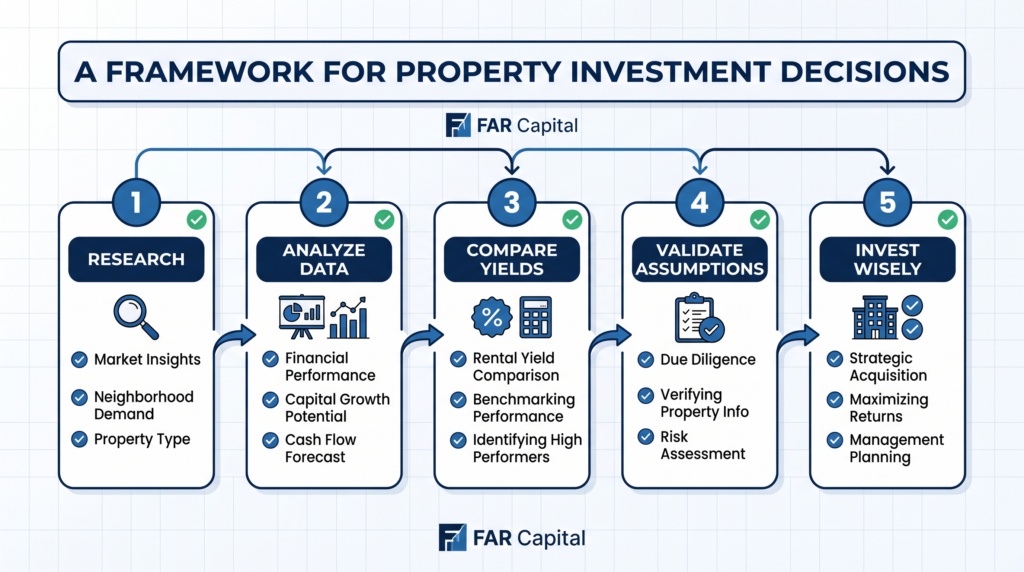
If prestige addresses do not define investment quality, what does? The answer lies in quantifiable fundamentals that predict sustainable returns.
Before committing capital, demand answers to these questions:
A “good location” is not a fixed category. It is a dynamic condition created by supply constraints, demand drivers, infrastructure investment, and appropriate pricing. Data reveals the distinction. Instinct obscures it.

The most expensive error is not picking the wrong unit. It is investing based on borrowed conviction rather than personal analysis.
When you buy because someone else said it was a prime spot, you absorb their assumptions without understanding their context. Their risk tolerance, financial position, and timeline differ from yours.
Start with market research before any viewing. Review transacted price data and rental statistics. Let numbers narrow your search, not social media recommendations.
Build a simple investment calculator. Track gross yield, net yield, and cash-on-cash return for every property. Comparing investments mathematically removes emotional bias.
Seek contrarian evidence actively. For every property you love, spend equal time investigating why it might fail. This prevents confirmation bias from dominating your analysis.
Establish written investment criteria before searching. Define target yield ranges, acceptable locations, maximum budget, and minimum specifications. When a property meets every criterion, act decisively. When it fails one criterion, walk away.

The Malaysian property market offers genuine wealth-building opportunities for investors who approach it with discipline and data. The “location, location, location” mantra served a different era. Today’s successful investor questions every assumption and lets numerical evidence guide capital allocation.
Ahmad’s story need not become your story. His losses were caused by relying on conventional wisdom instead of conducting independent analysis. Every overpriced trophy property and flooded rental market was visible in the data before the first investor signed the agreement.
The question is simple: will you follow the crowd, or will you follow the evidence? One path feels comfortable and socially validated. The other requires effort, intellectual humility, and the courage to disagree with conventional wisdom.
History rewards the latter. The investors who build lasting wealth are those who had the discipline to ask hard questions, demand numerical proof, and act on evidence rather than emotion. Your next property decision is an opportunity to choose which category you belong to. Choose wisely.

