
Are you earning a foreign income and looking to diversify your wealth into one of Southeast Asia’s most stable real estate markets? You’ve come to the right place.
At FAR Capital, we specialize in helping high-net-worth individuals and expatriates turn their global earnings into high-yield Malaysian assets.
Malaysia remains one of the most “foreigner-friendly” countries in Asia. Whether you are a Malaysian working in Singapore or a digital nomad in Dubai, leveraging your foreign income is the ultimate “cheat code” to building a massive property portfolio in Malaysia.
In fact, Malaysia is one of the most foreigner-friendly real estate markets in Asia. Whether you are looking to relocate, work here, or simply park your wealth in a high-growth asset, there is a clear legal pathway designed for you.

When you earn in SGD, USD, or EUR, your purchasing power in Malaysia is effectively “supercharged.” However, many investors struggle because they don’t know how to present their foreign income to local banks.
In 2026, the Malaysian ringgit offers an incredible entry point for those with offshore earnings. The process isn’t complicated, but it requires a strategic approach to ensure your loan documentation meets the stringent requirements of Bank Negara Malaysia.
The “How” depends entirely on your current status and your long-term goals. Here are the four primary routes to becoming a property owner in Malaysia.
The MM2H program is the “Gold Standard” for long-term investors. If you have a stable foreign income, this program provides a renewable long-term social visit pass, giving you the freedom to reside in the “Golden Land.”
The Investor Perk: Under the latest updates, MM2H holders often receive a higher Margin of Finance (MOF). Banks view these applicants as low-risk because of their high liquidity and consistent foreign income streams.
Watch here for the new revised MM2h Policy
If you are currently working in Malaysia but still receiving part of your compensation as foreign income or allowances from an MNC, the door is wide open.
The Eligibility: If you hold a valid Employment Pass (EP) or professional work visa, you are legally entitled to purchase property.
The Advantage: Banks view work permit holders, especially those in Tier 1 industries, very favorably. You are treated as a “resident” for tax purposes, which often leads to smoother loan approvals and more competitive interest rates than a pure non-resident.
You don’t need to live in Malaysia to own property here. Many FAR Capital clients live in Middle-East, Singapore and etc. They use their foreign income to capitalize on Malaysia’s capital appreciation.
The Strategy: Focus on “Tier 1” zones.
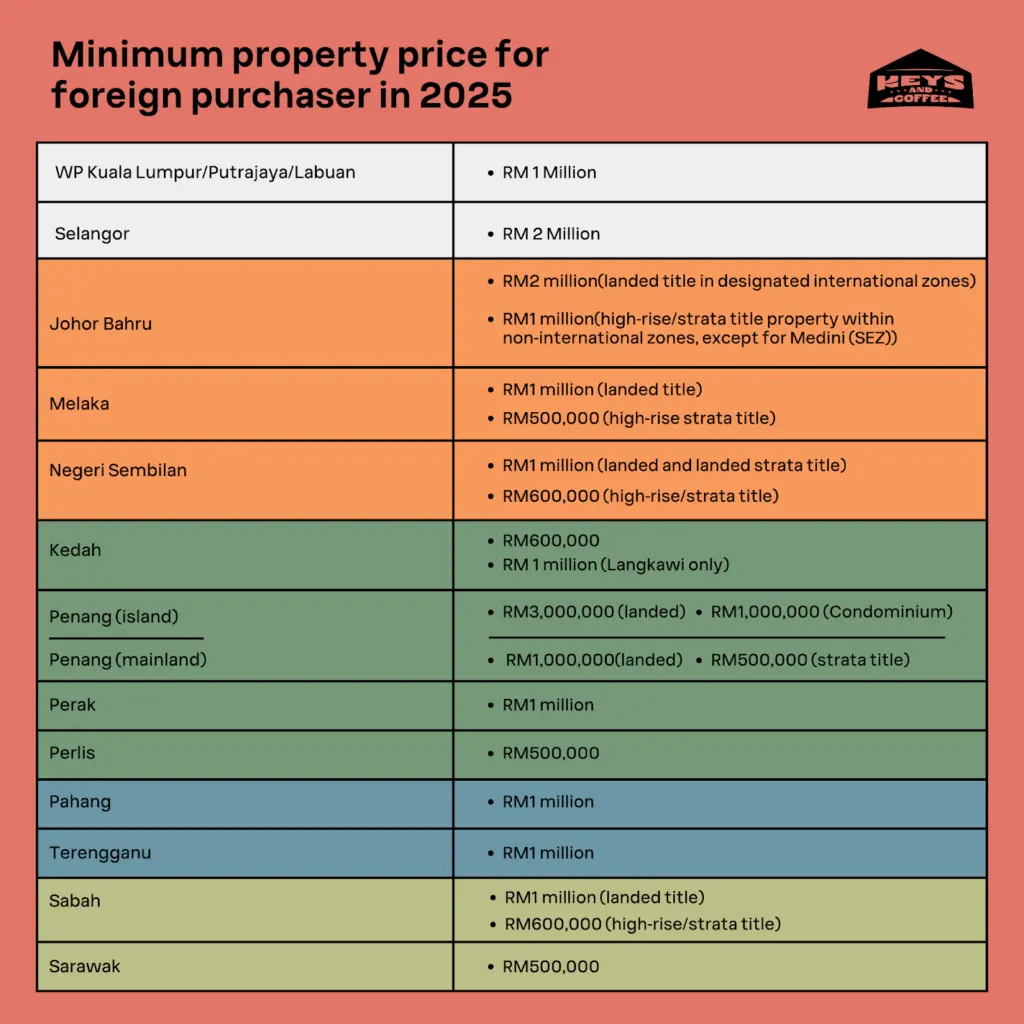
| State | Minimum Price (General) | Notes |
| Kuala Lumpur | RM 1,000,000 | Most popular for high-rise condos. |
| Selangor | RM 2,000,000 | Higher threshold to protect local landed housing. |
| Johor | RM 1,000,000 | Often reduced for designated “International Zones.” |
| Penang | RM 1,000,000 | Island prices differ from the mainland. |
Even with a foreign income, you must meet state-specific price floors. Generally, the minimum purchase price is RM1 million, but this varies significantly depending on the state and the type of property.
Because of our unique relationship with the “Red Dot,” Singapore citizens and residents have a distinct edge. With the SGD trading strongly, your foreign income goes three times further the moment you cross the Causeway.
Cross-Border Financing: Many Malaysian banks (such as Maybank, Public Bank, and CIMB) have dedicated “Singapore Desks”. They understand Singaporean credit profiles and offer specialized cross-border financing options that make the buying process seamless.
Financing Levels: Singaporeans can often secure a Margin of Finance (MOF) of up to 90%, allowing for incredible cash-on-cash returns.
How much can you borrow with a foreign income? This is the question we get most often at FAR Capital.
Typically, non-residents can expect a Margin of Finance (MOF) between 60% to 75%. However, if you have a strong foreign income profile or you are an MM2H holder, we have seen cases where banks offer up to 80% or 85%.
Key Documentation Needed:
Expert Tips for Maximizing Your Foreign Income: Using foreign income to invest isn’t just about buying a house; it’s about optimizing your debt-to-service ratio (DSR).
The Malaysian property market is currently in a “sweet spot.” Infrastructure projects like the RTS Link and MRT3 are nearing completion, and the entry price for those with a foreign income remains incredibly low compared to neighboring Singapore or Vietnam.
Don’t get stuck in “analysis paralysis.” Whether you choose the MM2H route or the Pure Investor path, the goal is to let the property start working for you. Your foreign income is a tool, use it to build a legacy in the “Golden Land” like Malaysia.

