
The property game in Malaysia these days is essentially a high-stakes face-off between standard “residential-only” enclaves and major “mixed-use” developments.
While traditional neighborhoods offer a quiet, exclusive retreat, mixed-use projects where stores, offices, and homes are bundled together have surged in popularity for city dwellers seeking the “15-minute city” lifestyle.
Whether you are a first-time homebuyer or a seasoned investor, your choice isn’t just about the floor plan. It is about identifying which setup will hold its value best and provide the strongest rental yield when market conditions shift. At FAR Capital, we don’t guess; we look at the data.
The core difference between these two asset classes lies in their integration.
While normal residential projects often score higher on exclusivity and lower maintenance fees (since they don’t share complex infrastructure with commercial units), they lack the built-in “footfall” that drives modern demand.
Thus, our research specifically targets high-growth Tier 2 segments to test performance:
Based on our research, here is data of rental yield stacks up across key hotspots:
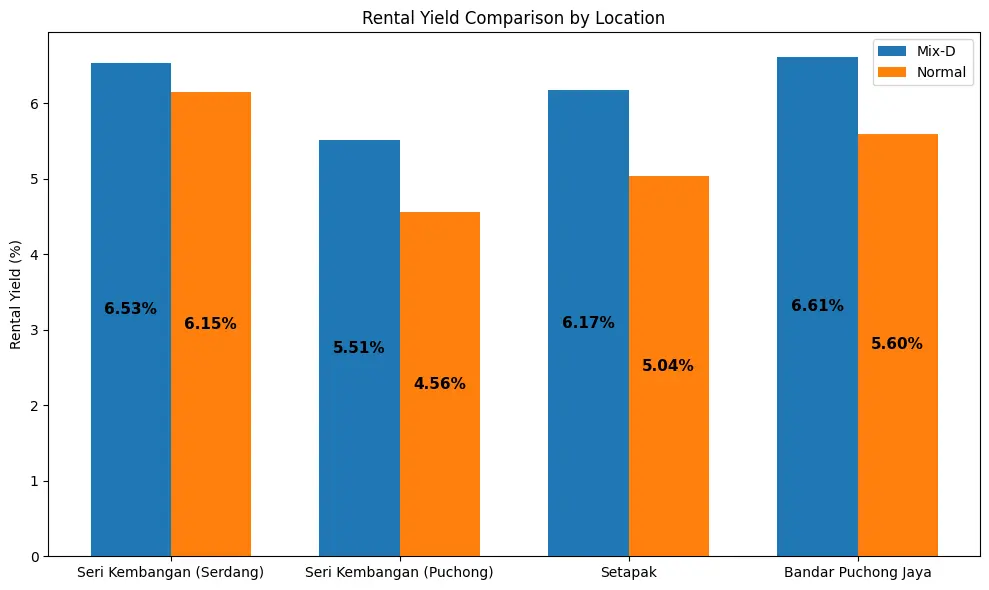
The numbers across Klang Valley’s high-growth segments tell a compelling story: Mixed Developments (Mix-D) consistently outperform normal residential blocks when it comes to generating a superior rental yield.

The Bottom Line: On average, mixed developments deliver a 6.21% rental yield, providing a 0.9% premium over the 5.34% average of normal residential properties.
Now, let’s take a look at the median price premium.
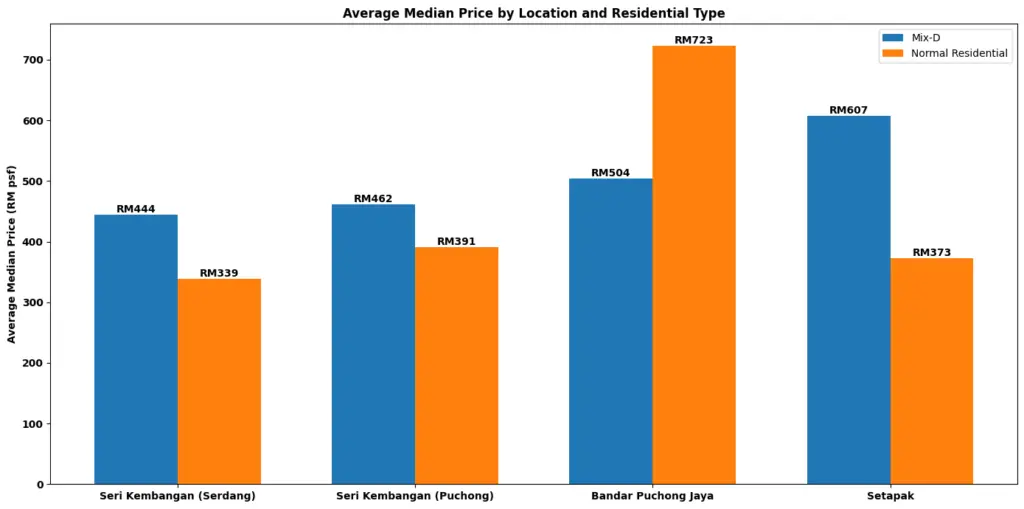
For this chart, we can see that in Seri Kembangan, mixed developments command a higher median price, estimated at RM440-470 psf, compared to RM340-400 psf for normal residential properties.
Bandar Puchong Jaya presents a contrasting scenario, where the median price for mixed developments is slightly lower at roughly RM504 psf, compared to RM723 psf for normal residential properties.
Setapak demonstrates the most significant price difference, with mixed developments averaging approximately RM607 psf, substantially higher than the RM373 psf median for normal residential properties.
This premium is likely due to the area’s density and tenant demographic, where mixed developments, such as Zetapark, offer high convenience. Residents are willing to pay the price for the sheer convenience of walking downstairs rather than driving 15-20 minutes for groceries.
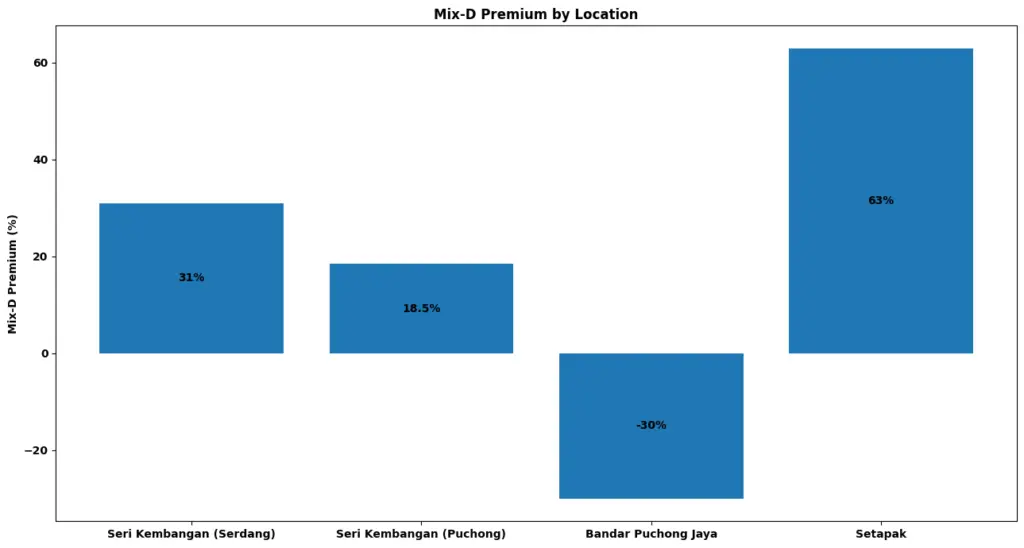
While mixed developments generally command a higher rental yield, the price premium varies significantly based on local demographics and property specifications.
Seri Kembangan: Mixed developments here maintain a healthy lead, commanding an 18-31% price premium over normal residential units.
Bandar Puchong Jaya: Interestingly, this location showed a 30% difference in favor of normal residential properties. This outlier is driven by high-end specifications; for instance, Skyz Condominium is a luxury-spec project by IOI Properties that outprices nearby mixed-use options.
Setapak: This area is the ultimate proof of our hypothesis, with mixed developments hitting a massive 63% price premium compared to normal residential. Projects like Zetapark act as “all-in-one” lifestyle hubs, offering a cinema, supermarket, and F&B options just an elevator ride away. This perfectly serves the student and young professional demographic who prioritize extreme convenience and walkability to secure a better rental yield.
The Takeaway: While integration usually wins, luxury specs and exclusivity can sometimes override the mixed-development factor in determining the final rental yield and asset value.

When analyzing which asset class will secure the best rental yield, we apply our proprietary filters to the data. Here is how Mixed Developments (Mix-D) and Normal Residential properties compare…
Price & Booster: Mix-D assets benefit from built-in boosters like retail and offices. However, you must ensure the entry price isn’t already “over-baked” by extreme premiums—such as the 63% seen in Setapak, which can compress your overall rental yield.
MRO & Cashflow: Mix-D generally offers superior Mortgage Reduction Objective (MRO). By targeting diverse tenant segments, including office workers, students, and retail staff, you create a resilient income stream to cover your installments.
ROC & MEO: While Multiple Exit Options (MEO) are higher for Mix-D because they appeal to both investors and home-seekers, your Return on Capital (ROC) may be slower if you overpaid on the initial price premium.
Exclusivity & Maintenance: Normal Residential properties often score higher on exclusivity. Their single-use concept can command higher rents in specific niche markets while benefiting from lower maintenance fees, as they don’t share infrastructure with commercial units.
Tenant Profile & Supply Risk: Mix-D assets attract high-turnover young professionals and students, which can lead to “rental war” risks in high-density areas. Conversely, Normal Residential projects tend to attract stable, long-term family tenants in lower-density environments.
This study analyzed whether Mixed-Use Developments (Mix-D) truly outperform Normal Residential properties in rental yield and price premiums across Klang Valley’s Tier 2 growth areas.
The findings clearly validate the first hypothesis: Mix-D consistently delivers superior rental performance, with an overall average rental yield of 6.21% compared to 5.34% for normal residential, which represents an approximate 0.9% rental yield premium.
Across Seri Kembangan, Setapak, and Bandar Puchong Jaya, mixed developments demonstrated stronger income-generating capacity, largely supported by integrated retail and office components, higher tenant turnover, and demand from students and young professionals who prioritize convenience and walkability.
From a cash flow perspective, Mix-D shows structural advantages due to diversified tenant pools and built-in demand drivers.
The second hypothesis that Mix-D commands a higher price premium is generally supported but remains location & development specification sensitive.
In areas like Seri Kembangan and especially Setapak, mixed developments achieved substantial price premiums (up to 63%), reflecting strong lifestyle appeal and density-driven demand. However, the case study in Bandar Puchong Jaya presents an exception where a higher-spec normal residential project outpriced its mixed-use counterpart, highlighting the importance of product positioning and quality.
Overall, while Mix-D demonstrates stronger rental yield and frequent pricing advantages, investment outcomes ultimately depend on entry price discipline, local demographics, and competitive supply dynamics.
Typically, mixed-development projects are expected to command a higher premium in price and rental yield compared to normal residential properties.
However, this hypothesis is not always realized, as outcomes can vary significantly from case to case due to various external factors. For instance, the case study in Bandar Puchong Jaya suggests that exclusivity and higher specification premiums might override the mixed-development factor in determining value.
The Bottom Line: While mixed developments frequently offer the best rental yield, your ultimate success depends on entry price discipline and local market dynamics.

